



















































































The Health Secrets of Saudi Coffee: A Scientific Investigation
Discover the surprising health benefits of Saudi coffee. This article details a scientific study that explores the link between daily Saudi coffee consumption and its positive effects on chronic diseases and mental health, comparing its unique multi-ingredient blend to black coffee and tea.
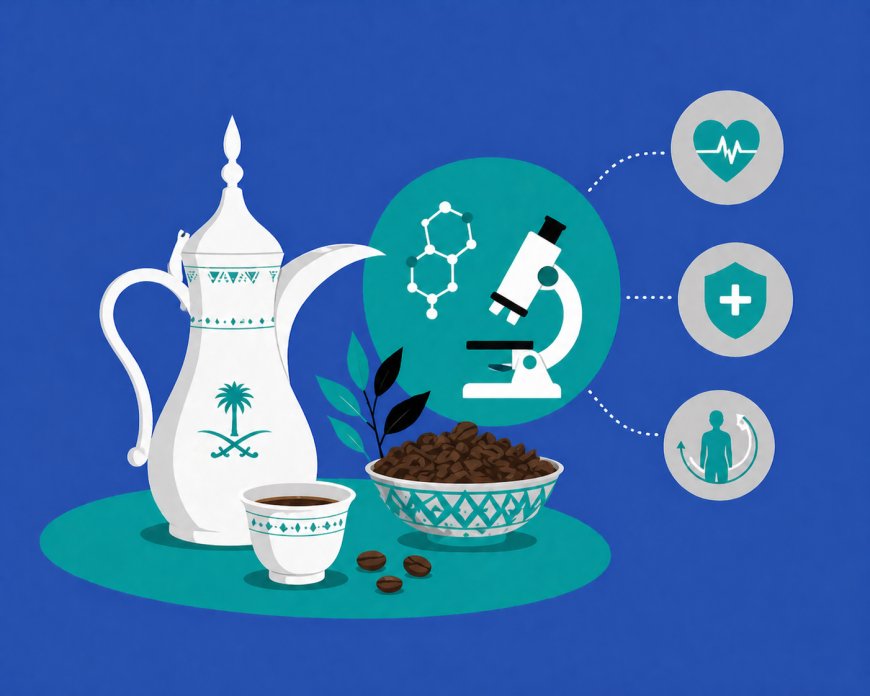
In 2022, the Saudi Ministry of Culture declared the Year of Saudi Coffee, positioning it not only as a cultural symbol but as a subject worthy of scientific and economic exploration. This initiative was reinforced through a knowledge grant in partnership with Saudi Coffee Company, opening a pathway for research that bridges heritage with evidence-based inquiry. For researchers working at the intersection of health and behavior, this moment represented more than cultural recognition. It introduced a question that had not been sufficiently explored: can Saudi coffee, as a composite beverage, produce measurable health effects beyond those attributed to its individual ingredients?


Global research trends provide context for this question. Black coffee has been extensively studied and is frequently associated with reduced risks of cardiovascular and liver diseases, as well as metabolic benefits such as fat oxidation. Similarly, Matcha tea has been positioned as beneficial for cholesterol regulation, blood pressure, and even cancer-related pathways, despite its core composition not being fundamentally different from other tea types. These cases illustrate how scientific evidence, combined with effective positioning, can transform a traditional beverage into a high-value functional product.
Saudi coffee differs structurally from both. It is not a single-compound beverage. In addition to coffee, it incorporates cardamom, cloves, saffron, and ginger. Each of these components has its own independent profile within nutritional and medical research. Saffron, for example, has been examined for its potential antidepressant effects. Ginger has been linked to anti-inflammatory and digestive benefits. Cardamom and cloves have been associated with antioxidant properties and metabolic regulation. The presence of these compounds within a single preparation introduces the possibility of interaction effects—where the combined impact exceeds the sum of individual contributions.
This concept is not speculative. It is grounded in established scientific practice. The combination of turmeric and black pepper provides a relevant precedent. While turmeric contains curcumin, a compound with strong antioxidant properties, its bioavailability is limited. Studies demonstrated that the addition of black pepper significantly enhances absorption, effectively amplifying its physiological impact. As a result, modern turmeric supplements routinely include black pepper as a standard component. This shift was not driven by tradition alone, but by empirical validation of interaction effects.
Applying this framework to Saudi coffee leads to a clear hypothesis: the combination of its ingredients may create a synergistic effect that influences health outcomes in ways that isolated components cannot. This hypothesis formed the basis of a national-level study conducted through Sharik Association for Health Research in collaboration with Informed Decision Making (IDM). The study utilized a large cross-sectional dataset representing participants from all regions of the Kingdom, aiming to examine the relationship between daily consumption of Saudi coffee and a range of health indicators, including chronic diseases, psychological symptoms, and behavioral patterns.
The analytical approach was structured in two stages. The first involved bivariate analysis, examining the direct relationship between Saudi coffee consumption and each health variable independently. This stage provides initial signals, identifying correlations without controlling for external factors. The second stage, currently underway, involves multivariate analysis, where multiple variables—such as age, gender, lifestyle, and consumption of other beverages like black coffee and tea—are controlled simultaneously. This step is essential to distinguish true associations from those influenced by confounding factors.
Preliminary findings from the initial analysis phase have produced notable observations, particularly in the psychological domain. Daily consumption of Saudi coffee was strongly associated with reduced symptoms of depression. This association was not observed with black coffee. Additionally, Saudi coffee consumption showed a strong relationship with lower levels of anxiety. While black coffee and tea also demonstrated associations with reduced anxiety, the magnitude of the effect was highest for Saudi coffee.
These findings do not establish causation. They indicate correlation. However, the strength and consistency of these associations provide a basis for further investigation. They align with the theoretical expectation that the combined ingredients of Saudi coffee may influence neurochemical pathways related to mood and stress regulation. If validated through controlled studies, these effects could position Saudi coffee not only as a cultural beverage, but as a functional intervention.
The next phase of research extends beyond observational analysis. It involves examining the chemical composition of Saudi coffee in detail, isolating active compounds, and testing their effects under controlled conditions. This may include experimental studies and, eventually, clinical trials to evaluate efficacy and safety. The objective is to move from correlation to mechanism, and from mechanism to application.
The implications are both scientific and economic. If the synergistic properties of Saudi coffee are confirmed, they open the possibility of developing standardized extracts or supplements derived from its composition. Such products could enter global markets, similar to how black coffee and Matcha have been positioned, but with a differentiated value proposition based on multi-component interaction.
This trajectory reflects a broader principle. Traditional practices often contain embedded knowledge that has not yet been formalized scientifically. The role of research is not to validate tradition uncritically, but to investigate it rigorously, extracting what can be measured, tested, and applied.
Saudi coffee, in this context, represents more than a beverage.
It represents a hypothesis.
One that connects culture, chemistry, behavior, and health.
And one that, if explored systematically, may redefine how a traditional practice is understood—
and how it is used.
What's Your Reaction?