























































































Cryptocurrencies: Entropy, Decentralization, and Thermodynamic Principles
Examining cryptocurrencies through the lens of thermodynamics reveals a new paradigm of information entropy and decentralization. By analyzing the energy dynamics underlying blockchain technology, this article explores the scientific principles governing its operation and implications for financial systems.

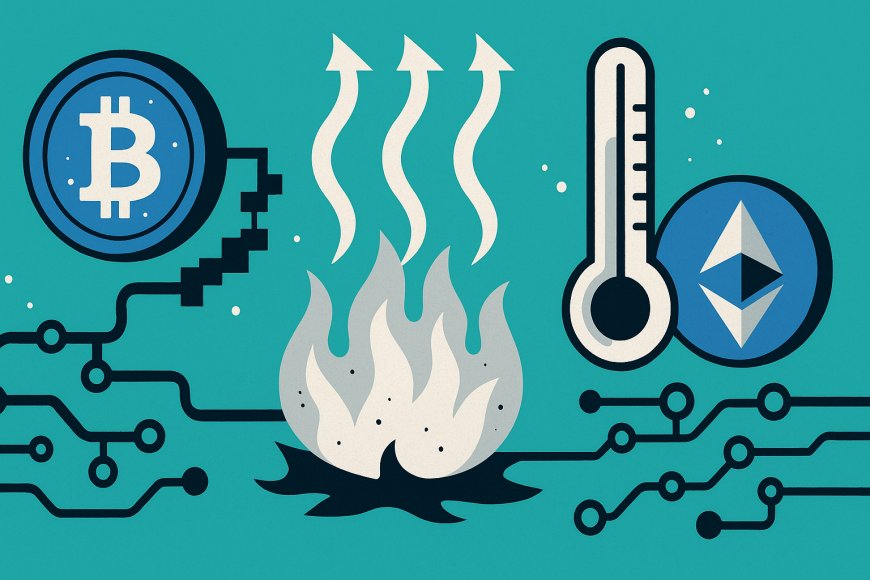
In a world increasingly reliant on digital currencies, the principles that govern these financial systems are often obscured by technological jargon and economic theories. Yet, a fascinating intersection exists between cryptocurrencies and the fundamental laws of thermodynamics, particularly entropy. Entropy, a measure of disorder in a system, can provide profound insights into the operational mechanics and sustainability of decentralized currencies.


Cryptocurrencies like Bitcoin operate on a blockchain, a decentralized ledger maintained across numerous nodes. This decentralization is not simply a technological feat but also an entropic one. Each node in the network contributes to the overall disorder, or entropy, of the system. The more nodes engaged, the higher the entropy, reflecting a decentralized and resilient network. In thermodynamic terms, cryptocurrencies aim for a state of maximum entropy, where information is distributed evenly across the system, minimizing the potential for central control and failure.
Blockchain as an Entropic Engine
Consider a typical blockchain network where transactions are recorded into blocks via a consensus mechanism like Proof of Work (PoW). In this setting, miners expend computational power to solve complex mathematical puzzles, securing the network and validating transactions. The energy consumed in this process is analogous to heat dissipation in thermodynamic systems. This energy dissipation is crucial; it represents the entropic cost of maintaining decentralization and security. As miners solve puzzles, they contribute to the network's entropy, ensuring no single node can dominate the blockchain. The system's security relies on this balance of energy expenditure and information distribution.
In this framework, entropy serves as a measure of decentralization effectiveness. A well-distributed network, high in entropy, can resist attacks and centralization attempts, akin to a thermodynamic system naturally evolving towards equilibrium. The entropic nature of a blockchain is reflected in its resistance to information monopolies, where power over the network is not concentrated but diffused across multiple agents.
To illustrate, imagine a scenario where a single entity attempts to control a significant portion of the mining power. The network's entropic properties counteract this by requiring an infeasible amount of energy and resources to maintain such control, thus preserving the decentralized essence of the cryptocurrency.
Thermodynamic Constraints and Cryptocurrency Scalability
The interplay of entropy and thermodynamics in cryptocurrencies extends beyond decentralization to scalability challenges. As networks grow, the entropic demands increase, influencing the system's scalability. The thermodynamic limits of energy consumption present a natural boundary to growth, where increasing network size requires exponential increases in energy expenditure. This mirrors the laws of thermodynamics, where systems require more energy to maintain order as complexity increases.
For example, in expanding blockchain networks, more energy must be consumed to sustain the entropic balance necessary for security. This energy consumption has practical and environmental implications, as seen in debates surrounding Bitcoin's carbon footprint. Yet, these challenges also spur innovation, as developers seek to optimize algorithms and explore alternative consensus mechanisms that align better with thermodynamic principles.
Such innovations include Proof of Stake (PoS) and other less energy-intensive consensus methods, which aim to reduce the entropic cost while maintaining decentralization. These emerging solutions reflect a deeper understanding of entropy’s role in cryptocurrencies, acknowledging the thermodynamic constraints and seeking to operate within them efficiently.
Decentralization, Entropy, and Financial Stability
Beyond technical mechanics, the thermodynamic principles of entropy in cryptocurrencies have broader implications for financial systems. In traditional financial models, centralization often leads to vulnerabilities, where a failure in a single point can lead to systemic collapse. Cryptocurrencies, inherently decentralized, offer an entropic alternative where information and power dispersion create resilience.
This decentralized resilience is crucial for financial stability in a world where digital currencies might increasingly replace traditional ones. Cryptocurrencies' ability to adapt to and thrive within the thermodynamic constraints can serve as a model for future financial systems, emphasizing the importance of entropy as a stabilizing force.
For instance, consider a financial system experiencing a macroeconomic shock. A decentralized cryptocurrency network, high in entropy, can absorb the impact more effectively than a centralized system, where concentrated points of failure exacerbate the crisis.
The thermodynamic perspective on cryptocurrencies presents an intriguing philosophical and scientific paradigm. As these digital currencies continue to evolve, understanding their entropic nature can guide us towards more resilient, efficient, and sustainable financial systems. The future of cryptocurrencies might well depend on our ability to harmonize technological innovation with the timeless laws of thermodynamics, ensuring that the information entropy inherent in decentralization becomes a bedrock of stability rather than a source of disorder.
What's Your Reaction?