















































Are We the Heroes of Our Stories or Mere Puppets? The Science of Genes and the Brain
Are our lives dictated by our genes or our free will? This article explores the dynamic interaction between genetics and the brain, revealing how we can use a scientific understanding of neuroplasticity and epigenetics to consciously shape our destiny and become the heroes of our own stories.
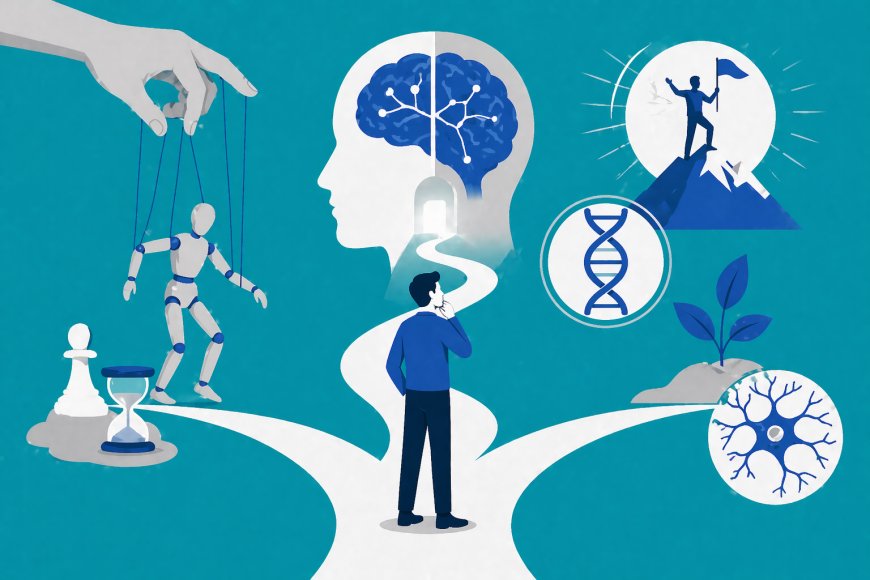
We have always been asked about our identity, our nature, and the source from which our thoughts and decisions flow. Are we truly the ones holding the reins, or are there invisible strings pulling us from behind the curtain? This question, which seems to arise from deep philosophical reflection, has also found its place in modern science, particularly in neuroscience and behavioral genetics.


Imagine that your life is not a blank canvas on which you paint freely, but rather an ancient manuscript in which some chapters were written before you were even born. This manuscript is your genetic code, known as DNA. These spiraling molecules are not just a biological blueprint for your body; they also shape, to varying degrees, your tendencies, whether toward introversion or sociability, optimism or caution, adventure or stability. They do not dictate your destiny entirely, but they define the range within which you operate.
Yet the story does not end with genes. There is another central force: the brain. This complex organ, weighing on average about 1.4 kilograms, is the engine behind every thought, action, and reaction. Its structure, neural connections, and responses are influenced by both genetic inheritance and environmental exposure. The concept of neuroplasticity offers a crucial insight: the brain is not fixed. It can reorganize itself, adapt, and evolve.
This means we are neither prisoners of our genes nor entirely shaped by our surroundings. We are the result of an ongoing interaction between inheritance and experience. This dynamic explains why two individuals raised in the same environment can develop entirely different personalities. It is the interplay between what was given and what was formed.
Understanding this balance is the first step toward gaining control over our behavior. It reframes the relationship between biology and will. It is not a conflict, but a partnership. Genes may provide the tools, but their use remains open.
This perspective invites a deeper question: how can this understanding be applied in daily life?
Genes can be viewed as a set of possibilities rather than fixed outcomes. For instance, a person may carry a genetic tendency toward anxiety or negative thinking. This does not mean that such outcomes are inevitable. The field of epigenetics shows that environmental factors and daily behaviors can influence how genes are expressed. Regular physical activity, balanced nutrition, and mental practices such as meditation can contribute to regulating these tendencies.
The brain, in turn, becomes the field where change is actively shaped. Through neuroplasticity, repeated behaviors and experiences alter neural pathways. Learning a new skill, practicing a discipline, or even resisting a habitual reaction gradually reshapes how the brain functions. Over time, these changes become embedded, influencing identity and behavior.
Practical application of this understanding can be approached through three main dimensions:
Self-awareness involves observing personal tendencies and recognizing patterns without immediate judgment. This awareness creates space between impulse and action.
A supportive environment reduces friction. Structuring surroundings to align with goals makes desired behaviors more accessible and consistent.
Repetition builds structure. Small, consistent actions, when repeated, reshape neural pathways and establish lasting change.
Over time, these elements transform intention into practice, and practice into identity.
In the end, the question is not whether we are controlled or free, but how we engage with the forces that shape us. We are neither passive recipients of biology nor entirely independent from it. Rather, we operate within a system that allows influence, adaptation, and direction.
You are not merely part of the story. You are also shaping it.
What's Your Reaction?