Network Theory and the Science of Connectivity: Understanding Complex Systems
Network theory elucidates the structural patterns and dynamics of interconnected systems across disciplines. By examining case studies from ecosystem interactions to social networks, the article delves deep into how network theory provides a robust framework for understanding complex systems. Various network types, their properties, and the significance of centrality measures are explored, exposing the intricacies of connectivity that underpin the fabric of scientific inquiry. The article anticipates future directions in network theory and its potential to redefine our understanding of interrelationships in various scientific domains.

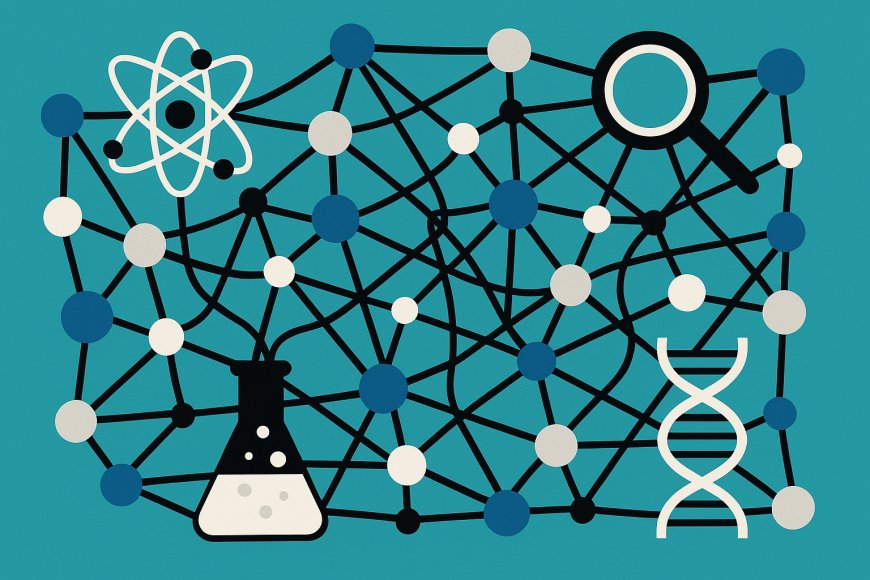
Imagine a bustling metropolis, where the city's lifeline is an intricate web of roads, bridges, and tunnels. This web not only connects its physical infrastructure but also orchestrates the flow of information, resources, and energy. Such a system's complexity and dynamics can be deciphered through network theory—a mathematical framework that explores how different nodes (cities, organisms, computers) are interconnected through edges (roads, ecological interactions, data flows).


Network theory is not confined to physical networks; it extends its reach to the abstract. Consider the web of relationships in an ecosystem. Each species, a node, interacts with others in a web of predation, competition, and cooperation. Such intricate interactions dictate the ecosystem's health and resilience. Network theory offers a lens to visualize these interactions, enabling scientists to predict how changes in one part of the web might ripple through the entire system.
In a typical observational study, researchers might map the interactions within a local ecosystem, identifying keystone species and their influence on ecological networks. By applying network theory, they can simulate scenarios where specific species are removed or introduced, providing insights into potential cascading effects. Such predictive power is pivotal in conservation strategies, where maintaining the integrity of the network is paramount for ecosystem sustainability.
Types of Networks and Their Properties
Networks are as diverse as the systems they describe. They can be classified broadly into random networks, where connections occur with equal probability, and scale-free networks, characterized by few highly connected hubs amidst many sparsely connected nodes. The Internet exemplifies a scale-free network, where a small number of websites receive the majority of traffic.
Random networks, although simpler, provide valuable insights. In epidemiology, modeling disease spread as a random network helps understand infection patterns and potential outbreak dynamics. Yet, real-world networks often exhibit non-randomness, necessitating more sophisticated models like small-world networks, where most nodes are not directly connected but can be reached through a small number of intermediaries. This property explains the phenomenon of 'six degrees of separation' in social contexts.
Consider a social network study within a university setting. Researchers might observe how information, trends, or behaviors spread among students. By analyzing the network's structure, the study can reveal influential students (hubs) who act as conduits for information dissemination. Understanding these dynamics is crucial for strategies in public health, marketing, and education where targeted interventions can leverage existing networks.
The Significance of Centrality Measures
Centrality measures in network theory identify the most influential nodes within a network. These measures, such as degree centrality, closeness centrality, and betweenness centrality, provide different perspectives on a node's importance. Degree centrality considers the number of direct connections a node has, highlighting its immediate influence. Closeness centrality measures how quickly information can spread from a node to others, emphasizing its reach across the network.
Betweenness centrality, on the other hand, assesses a node's role as a bridge in the network, capturing its potential to control the flow of information. In a typical business network analysis, identifying nodes with high betweenness centrality allows companies to understand which employees facilitate communication and innovation.
In a practical scenario, consider a network analysis of a corporate environment, where data is collected on employee interactions. Applying centrality measures reveals key connectors and bottlenecks within the organization. Such insights can influence organizational restructuring to enhance communication efficiency, fostering a more collaborative work environment.
The Future of Network Theory in Scientific Inquiry
The application of network theory is expanding, driven by advancements in data collection and computational power. As networks become increasingly detailed, their analysis promises to revolutionize fields ranging from neuroscience, where brain connectivity maps reveal cognitive processes, to economics, where financial networks elucidate market dynamics.
Network theory's potential to model complex interconnections continues to challenge traditional methodologies. As new network constructs emerge, they may redefine how scientists approach questions of causality, resilience, and adaptation in dynamic systems. Future research is likely to explore multi-layered networks, capturing interactions across different scales, layers, and contexts, offering a more holistic view of interconnected systems.
What's Your Reaction?