








































































Behavioral Economics: Challenging the Predictive Power of Rational Models
Behavioral economics challenges traditional economic assumptions of rationality by incorporating psychological insights into human decision-making. This article explores the limitations of rational models and presents scenarios where behavioral factors predict outcomes more accurately. By examining specific experiments and critiques, the article highlights the need for revised economic frameworks that account for cognitive biases and irrational behaviors. The future of economic modeling may significantly shift as more complex human behaviors are integrated into economic theories.

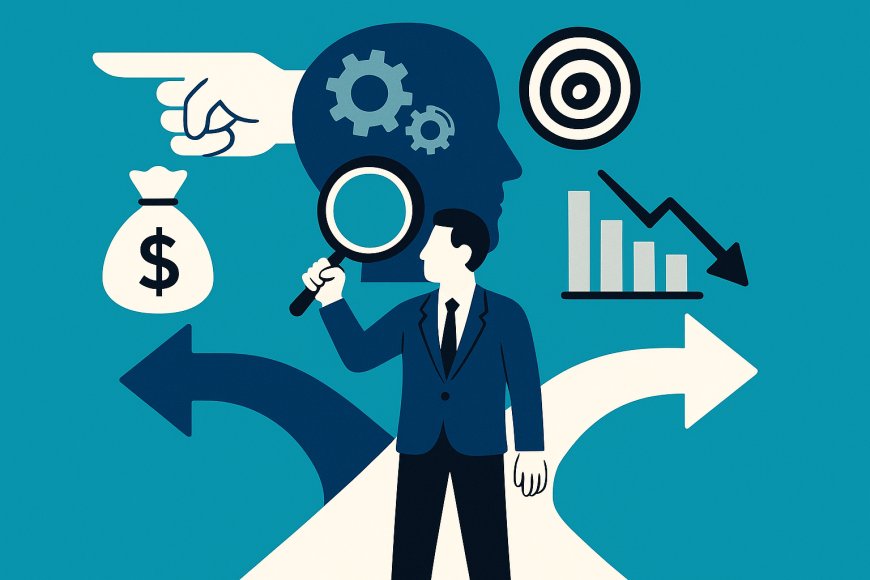
A typical economic model assumes rationality, predicting that individuals will make decisions that maximize their utility. Yet, consider the phenomena of limited self-control and imperfect information. Imagine a consumer choosing between saving money or buying impulse items. Traditional models predict rational saving, but behavioral economics offers a different perspective, as real-life choices often deviate from rational expectations.


In an observational study at a major university, researchers set up a cafeteria with two identical snack options. One was labeled "healthy choice," the other "popular choice." Despite health benefits being well-known, a majority consistently chose the "popular choice," illustrating preference skewed by social influence rather than individual benefit. This breaks from rational economic predictions, highlighting the role of perceived popularity in decision-making.
Behavioral economics proposes that cognitive biases, such as anchoring or framing effects, shape real-world decisions. These biases demonstrate that human behavior often violates the axioms of expected utility theory. In the classical economic framework, decision-making processes are static and context-independent. However, behavioral frameworks acknowledge that context, emotions, and cognitive distortions profoundly affect economic decisions.
Reassessing Economic Models: The Role of Cognitive Bias
In a behavioral experiment, participants were asked to choose between two equally valued financial investments. One investment was framed with a high-probability gain, the other with a low-risk potential loss. Predictably, the majority selected the former, despite equivalent expected values. This illustrates the framing effect, a cognitive bias where the presentation of information significantly alters choices.
Traditionally, economic models rely on prediction fidelity, positing that rational actors make consistent choices aimed at utility maximization. Behavioral economics, however, reveals inconsistencies. These inconsistencies emerge from bounded rationality, where decision-making is influenced by cognitive limitations and emotional responses.
A critique of rational models comes from the study of nudge theory, where subtle policy shifts influence behavior without restricting options. In a large-scale field trial, default enrollment in retirement savings plans significantly increased participation rates, demonstrating how altering default settings effectively modifies behavior, contradicting rational model predictions that would expect a neutral response to default changes.
Behavioral Economics in Policy-Making
Consider a policy initiative aimed at reducing energy consumption. Rational models might suggest awareness campaigns to directly inform consumers of energy-saving benefits. Yet, behavioral interventions, such as feedback on peer consumption, have shown to be more effective. An experiment in a suburban community demonstrated a 15% reduction in energy usage when residents received reports comparing their consumption to that of their neighbors, tapping into competitive instincts and social comparison.
These insights challenge classical policy-making assumptions that prioritize information dissemination. By incorporating behavioral nudges, policymakers can more effectively shape consumer behavior. Behavioral economics, therefore, provides a nuanced framework for understanding and influencing decision-making in contexts where traditional economic approaches fall short.
Critics argue that while behavioral interventions are influential on small scales, broader applications may encounter resistance due to deeply ingrained rationalist ideologies. Nevertheless, the growing body of evidence highlights the limitations of classic economic models, advocating for integrated approaches that encompass psychological insights.
Future Directions: Integrating Complex Behavioral Dynamics
The continued integration of behavioral insights into economic modeling presents both opportunities and challenges. As complexity in human behavior is better understood, models must evolve to incorporate these insights. Future research may focus on developing predictive models that balance rational and irrational elements, accounting for anomalies in human behavior.
Moreover, advancements in data analytics and computational power offer potential for more sophisticated models, capable of simulating behavior under diverse socio-economic scenarios. These models could redefine how economic theories predict outcomes, aligning them closer to observed realities.
The trajectory of economic thought may witness a paradigm shift, where acknowledging the intricacies of human behavior becomes central to the discipline. Behavioral economics does not signal the demise of rational models but rather their evolution into tools that better reflect the complexity of human nature.
What's Your Reaction?