








































































Architectural Paradigms in Computer Engineering: From von Neumann to Quantum Computing
This article explores the evolution of computer architectures, from von Neumann's seminal framework to the revolutionary concepts underpinning quantum computing. It examines how these paradigms inform methodological ideas in computer engineering.

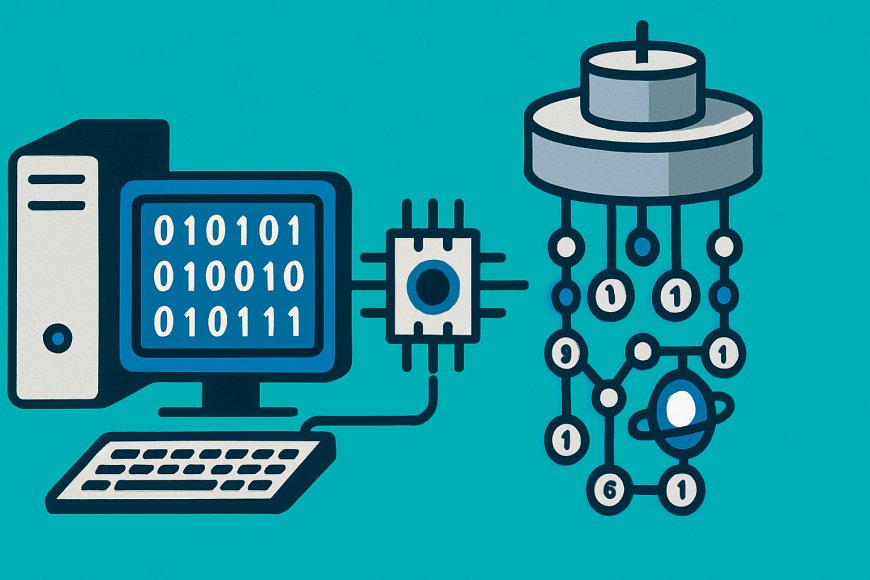
The foundational architecture of computing, known as the von Neumann architecture, is ubiquitous in modern computing systems. Developed during the mid-20th century, von Neumann's design proposed a system where a single set of arithmetic and control units processes both data and instructions stored in the same memory. This model introduced the concept of a stored-program computer, which remains a cornerstone of computer engineering. However, as computational needs grew, the limits of this architecture became apparent, prompting a search for more efficient alternatives.


Consider a computational task requiring rapid execution of parallel processes. The von Neumann architecture, with its sequential processing, struggles under such demands. This bottleneck, known as the von Neumann bottleneck, necessitated alternative approaches, leading to innovations such as parallel processing and distributed computing. In a typical scenario, a high-performance computing laboratory might employ thousands of interconnected processors to solve complex simulations, such as climate models or molecular dynamics, which are infeasible on conventional single-processor systems.
The Rise of Parallel and Distributed Architectures
Parallel and distributed architectures emerged as solutions to the limitations of sequential processing. These systems exploit concurrency, allowing multiple processes to execute simultaneously, thereby enhancing computational speed and efficiency. In parallel computing, a task is divided into sub-tasks that are processed concurrently on multiple processors. Consider a weather prediction model where atmospheric data is parsed into smaller datasets, each processed simultaneously by a network of processors. This approach significantly reduces computation time, enabling real-time weather forecasting.
Distributed computing expands this paradigm by connecting multiple computers over a network to work on a single problem. The Internet itself is a testament to distributed architecture's capability, where data and computational tasks are shared across billions of devices globally. In a research setting, distributed computing platforms like SETI@home leverage idle computational power from volunteers worldwide, analyzing vast datasets in the search for extraterrestrial intelligence. Such systems demonstrate the scalability and resilience of distributed architectures.
Yet, these architectures introduce new challenges. Synchronizing data and managing communication between processors require sophisticated algorithms and protocols. In a typical control system, ensuring coherence and consistency of data across distributed nodes demands meticulous planning and robust error handling mechanisms. Researchers continue to explore innovative solutions to address these complexities, ensuring efficient and reliable parallel and distributed computing systems.
The Revolution of Quantum Computing
Quantum computing represents a paradigm shift in computer architecture, leveraging the principles of quantum mechanics to perform computations far beyond the capabilities of classical systems. Unlike classical bits, which exist as either 0 or 1, quantum bits (qubits) can exist in multiple states simultaneously, thanks to superposition. This property allows quantum computers to process a vast amount of data concurrently, offering exponential speed-ups for specific tasks.
Consider a cryptography problem such as factorizing large integers, a challenge insurmountable for classical computers within a reasonable timeframe. Quantum algorithms, like Shor's algorithm, can solve such problems exponentially faster by exploiting the parallelism inherent in quantum mechanics. In a hypothetical lab setting, a quantum computer could break modern cryptographic codes, heralding transformative implications for data security.
Despite its potential, quantum computing remains in its infancy, grappling with challenges such as qubit coherence and error rates. In a typical experimental setup, researchers use cryogenic systems to maintain qubits at near absolute zero, preserving their quantum states. Error correction algorithms are critical to mitigate decoherence and maintain computational integrity. The pursuit of a practical, scalable quantum computer continues to inspire novel methodologies in computer engineering.
As the frontiers of computer architecture expand, the interplay between classical and quantum paradigms offers a fertile ground for innovation. The integration of quantum principles into conventional computing heralds a future where hybrid systems harness the strengths of both realms, unlocking unprecedented computational capabilities.
The evolution of computer architectures reflects the dynamic nature of computer engineering, driven by the quest for efficiency and innovation. With quantum computing on the horizon, the future promises a transformative shift in how we process information, challenging and enriching our understanding of computation itself.
What's Your Reaction?