










































































Reevaluating the Role of Cultural Transmission in Human Evolution
Cultural transmission profoundly influences human evolution, shaping behaviors, beliefs, and technologies. This article examines the intricate dynamics of learning, the impact of innovation diffusion, and the symbiotic relationship between genetic and cultural evolution.

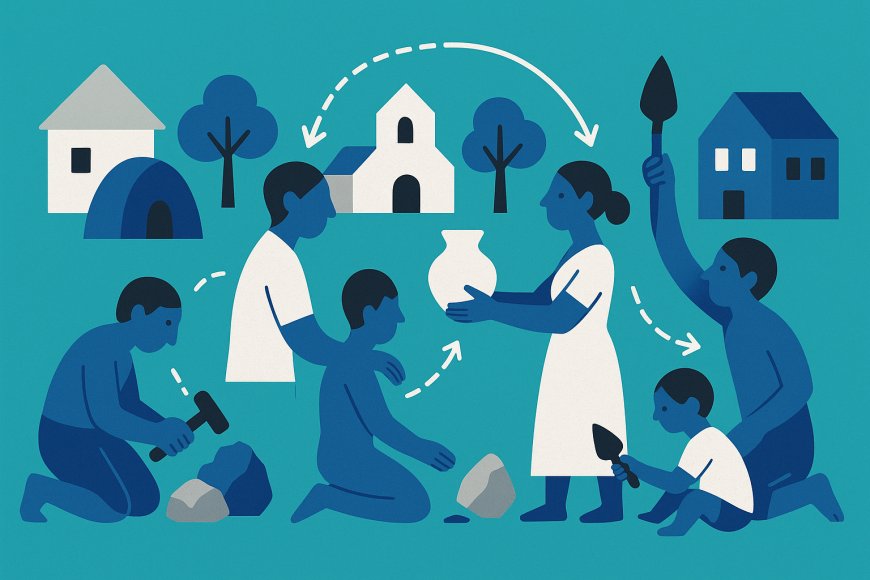
Consider a typical group of primates in their natural habitat. These animals exhibit learned behaviors passed down through generations, from tool use to social organization. Such behaviors are not merely incidental; they are pivotal in shaping the species' evolutionary trajectory. While the role of genetic evolution in these processes is recognized, the influence of cultural transmission on human evolution remains an area ripe for further exploration. Cultural adaptations, unlike genetic ones, can occur within a single generation, leading to rapid shifts in societal practices and technological advancements.


A closer examination reveals that cultural transmission differs fundamentally from biological inheritance. Genetic information is passed vertically from parent to offspring, whereas cultural information can spread horizontally across individuals in a community. This dissemination can occur through various mechanisms, including imitation, instruction, and symbolic communication. Thus, cultural transmission provides a flexible and dynamic repository of adaptive knowledge that complements genetic evolution, allowing human populations to adjust to new environments and challenges with remarkable agility.
The Mechanics of Cultural Learning
In the heart of a bustling human settlement, a behavioral experiment might illustrate how cultural practices are disseminated. Participants in such a study might engage in a task requiring the use of a novel tool. Observers unfamiliar with the tool could witness its use and later replicate the actions, demonstrating the efficiency of observational learning. This process, known as social learning, is a cornerstone of cultural transmission. It enables individuals to acquire new skills and knowledge without direct experience, reducing the need for repetitive trial and error.
Social learning is not a monolithic process; it encompasses diverse strategies. For instance, in a laboratory setting, researchers might simulate different learning environments to observe the impacts on information retention and transmission. One group may engage in direct instruction, where a knowledgeable individual explicitly teaches others. Another group may rely on imitation, where learners observe and mimic the actions of their peers. Comparing these conditions can reveal insights into the underlying cognitive mechanisms and social structures that facilitate cultural learning.
The implications of cultural learning extend beyond the immediate acquisition of skills. Over time, accumulated knowledge can lead to cumulative cultural evolution. Innovations build upon existing ideas, resulting in complex technologies and social systems. This cumulative nature distinguishes human cultural evolution from simpler forms of animal culture, where behaviors are often limited to rudimentary tool use or basic social structures.
Innovations and Their Diffusion
Reflect on the rapid spread of a technological innovation like the internet. Its adoption globally exemplifies the power of cultural diffusion. Initially confined to small groups of researchers, the internet's exponential growth illustrates how innovations can transcend geographical and cultural boundaries. Such diffusion is not merely about adoption but involves adaptation and integration into existing cultural frameworks.
In a typical observational study, researchers might track the spread of a new agricultural technique within a rural community. The adoption of this technique could depend on factors such as perceived benefits, compatibility with existing practices, and the influence of early adopters. These factors highlight the complexity of cultural diffusion, as it requires both innovation and the willingness of social networks to embrace change.
The symbiotic relationship between innovation and diffusion underscores the adaptive capacity of cultural transmission. When a breakthrough occurs, its dissemination can rapidly transform societies, often outpacing the slower processes of genetic change. This phenomenon underscores the dynamic interplay between cultural practices and evolutionary pressures, illustrating how cultural transmission can drive human evolution.
Genetic and Cultural Evolution: A Symbiotic Relationship
In a remote village, an anthropological field study might investigate interactions between cultural practices and genetic selection. For example, the prevalence of lactose tolerance in certain populations is a testament to the mutual influence of cultural and genetic evolution. Pastoralist communities, relying heavily on dairy, have experienced genetic adaptations enabling them to digest lactose into adulthood. Here, cultural practices have directly influenced genetic selection, illustrating the bidirectional relationship between these evolutionary processes.
This interplay is not limited to dietary practices. Consider the evolution of language, a quintessentially human trait. Linguistic diversity results from cultural evolution, yet it also affects genetic evolution by influencing patterns of migration and inter-population contact. Such examples reveal that cultural and genetic evolution are intertwined, with each influencing the trajectory of the other.
In contemporary research, methodological advancements enable deeper exploration of this symbiotic relationship. Genetic studies combined with ethnographic research provide nuanced insights into how cultural practices shape genetic evolution and vice versa. This interdisciplinary approach enhances our understanding of human evolution, emphasizing the need for methodologies that bridge biological and cultural perspectives.
The intricate dance between cultural transmission and human evolution continues to challenge conventional assumptions. As we probe deeper into this relationship, we uncover a complex web of interactions that has shaped human history. Future research will likely expand our understanding of how cultural practices not only influence but actively drive evolutionary change. The potential for new discoveries in this field remains vast, offering fresh perspectives on the ever-evolving tapestry of human existence.
What's Your Reaction?