Beyond Calories: Why Modern Obesity Science is Rewriting the Rules
This article challenges the calories in versus calories out model of weight loss, exploring how genetics, metabolism, and the food environment play a more complex role in obesity.
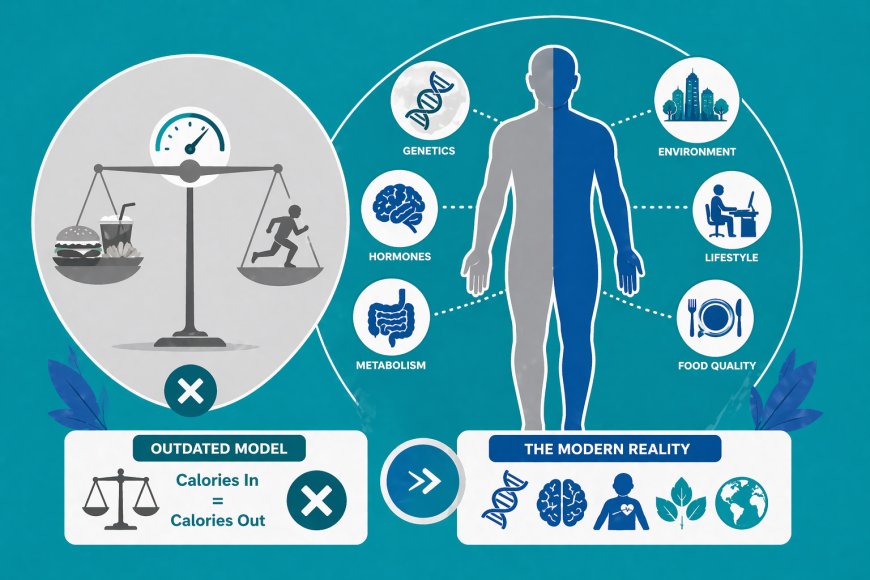
The principle of calories in versus calories out has long dominated nutritional thinking, shaping public health advice and weight loss strategies. Yet modern scientific evidence challenges this simplified equation, revealing that human biology does not operate like a mechanical system. As presented in contemporary research, calories are not a sufficient or fair measure to understand nutrition or control weight.


The origin of calories and their biological limitation
A calorie is a physical unit that measures the energy required to raise the temperature of water. This measurement, derived from laboratory tools such as the bomb calorimeter, does not reflect how the human body processes food.
Inside the body, digestion, absorption, and storage depend on enzymes, hormones, and complex metabolic pathways. The actual energy extracted from food varies significantly depending on its composition. Foods rich in fiber, for example, may deliver less usable energy than their labeled values suggest.
Not all calories are equal
Different macronutrients produce different metabolic and hormonal responses:
Protein requires more energy to digest and promotes satiety through hormonal signaling.
Refined carbohydrates trigger rapid insulin spikes followed by hunger.
Fats vary in effect depending on their type and digestion rate.
Reducing nutrition to a single numerical value ignores these fundamental biological differences.
Genetics and biological individuality
Weight regulation is strongly influenced by genetic and hormonal factors. Appetite, metabolism, and fat distribution are governed by complex systems involving genes such as MC4R and FTO.
Research indicates that a significant proportion of variation in body mass is genetically influenced. This explains why individuals following identical diets may experience entirely different outcomes.
The brain, particularly the hypothalamus, plays a central role in regulating hunger and energy balance through hormones such as leptin and ghrelin. Disruptions in these systems, such as leptin resistance, can sustain hunger even when energy stores are sufficient.
The food environment and systemic influence
Modern food environments are structured in ways that promote overconsumption. Ultra processed foods are widely available, highly palatable, and designed to stimulate reward systems in the brain.
Experimental evidence shows that individuals consume significantly more calories when exposed to these foods, even when nutritional composition appears similar. This demonstrates that behavior is shaped not only by choice, but by environment.
Social and economic conditions further reinforce this effect. Limited access to healthy food options, time constraints, and stress all contribute to patterns that cannot be explained by individual will alone.
The limitations of calorie counting
Calorie labeling itself is not fully precise. Regulatory standards allow significant margins of error, and actual energy absorption varies between individuals.
Differences in metabolism, microbiome composition, hormonal state, and daily activity all influence how calories are processed. Even small inaccuracies in measurement accumulate over time, affecting outcomes.
Focusing solely on calorie counting oversimplifies a complex biological reality and may lead to misleading conclusions.
Adaptive metabolism: the body responds
When calorie intake is reduced, the body activates protective mechanisms to conserve energy. This adaptive response lowers metabolic rate, increases hunger, and reduces spontaneous physical activity.
Hormonal changes, including reduced leptin and thyroid hormones, reinforce this state. Over time, the body becomes more efficient at conserving energy, making further weight loss increasingly difficult.
This explains why strict calorie restriction often leads to weight regain rather than sustainable change.
Redefining the relationship with food
Modern nutritional science calls for a shift away from rigid control and toward a more integrated understanding of eating behavior.
Approaches such as intuitive and mindful eating emphasize awareness of hunger and satiety signals, rather than strict numerical targets. These frameworks aim to restore balance between physiological needs and behavioral patterns.
At a broader level, improving nutrition requires changes in the food environment, including better access to healthy options and reduced exposure to highly processed products.
Conclusion
Understanding weight and nutrition requires moving beyond the narrow lens of calories. The human body operates through a complex interaction of biology, environment, and behavior.
Effective strategies must account for these factors, focusing on food quality, metabolic response, and sustainability rather than numerical simplification.
What's Your Reaction?