















































































From a Job to a Calling: The Researcher's Journey
Explore the profound difference between a job and a calling through one researcher's journey. This article delves into the motivations for a career in scientific research and the challenges of balancing passion with professional demands.
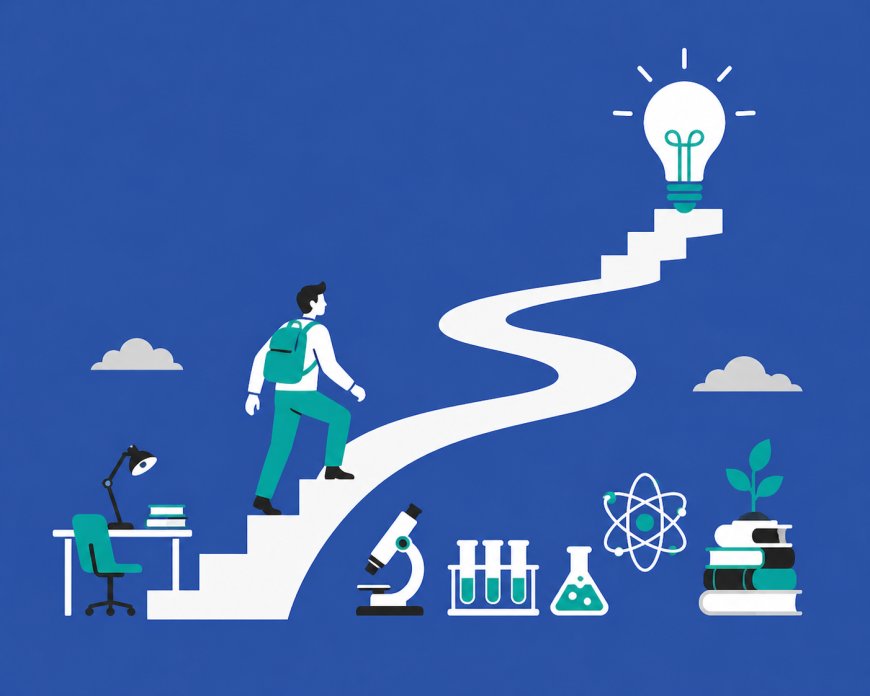
Before explaining why I chose research, it is necessary to clarify a distinction that shapes entire lives yet is often misunderstood: the difference between a job and a calling. A job is a structure. It is how we sustain ourselves, how we participate in institutions, how we maintain dignity through contribution. It does not have to reflect our deepest interests, but it must be performed well. Competence in a job is not optional; it is a requirement for stability.


A calling operates on a different axis entirely.
It is not assigned, nor is it immediate. It emerges slowly, often without clarity in the beginning, and requires time to recognize and a lifetime to refine. It may exist outside the boundaries of one’s formal work, yet over time it becomes more central than any job. It is not what you do to live. It is what gives meaning to living.
The mistake many make is to confuse the two—or worse, to force one into the structure of the other too early. Directing young individuals toward a fixed calling assumes a level of self-awareness that does not yet exist. A calling cannot be prescribed. It must be discovered through experience, tension, curiosity, and exposure.
My own path into research did not begin as a strategic decision.
It began as a question.
A persistent curiosity about knowledge itself. Not just what we know, but how we know. Who produces knowledge? What processes transform uncertainty into evidence? Why are some ideas accepted while others disappear? And eventually, a more direct question: if knowledge is created by individuals, why should I not be one of them?
This shift—from consuming knowledge to questioning its origin—was decisive.
Toward the end of my undergraduate studies, I encountered research not as an academic requirement, but as a system. A structured process through which ideas are tested, refined, and translated into something that others can use. Research revealed itself as the factory of knowledge, and methodology as its machinery. It was not abstract. It was operational.
What followed was not clarity, but complexity.
The pathway into research was not linear. It did not resemble traditional career trajectories. There was no single entry point, no defined progression, no guarantee of outcome. The assumption that research belongs primarily to academia proved incomplete. In reality, a significant portion of impactful research—particularly that which becomes products or applied solutions—is generated outside universities, within private sector environments and specialized research centers.
What initially appeared chaotic was, in fact, a distributed system.
A system that operates across institutions, sectors, and disciplines, often invisibly, yet forms the backbone of modern civilization.
This realization did not discourage me.
It intensified the pursuit.
Because the motivation was not external.
It was internal.
The desire was not simply to understand knowledge, but to create it. To produce something that could be read, used, and integrated into the lives of others. There is a distinct moment in research when an idea moves from isolation into shared existence—when it is published, interpreted, and applied. That moment carries a weight that is difficult to replace with any other form of achievement. It is not recognition that drives it. It is contribution.
This internal drive shaped the development of specific skills, not through formal instruction alone, but through repetition. Self-learning became a necessity. Failure became a constant. Experiments did not succeed by default. They required persistence, iteration, and the willingness to revisit assumptions. Over time, the focus shifted from outcomes to process—from seeking correct answers to refining the way questions are asked.
With this shift, fear began to lose its influence.
Fear of failure, of criticism, of uncertainty.
Because the identity was no longer tied to a single result.
It was tied to the act of inquiry itself.
At a certain point, research moved beyond interest.
It became structure.
A way of thinking, of analyzing, of interpreting the world.
And with that, it became inseparable from identity.
The transition into academia appeared, at first, to be a natural extension. Research was embedded within the academic system, supported by incentives, recognition, and institutional frameworks. Yet the experience introduced a tension that had not existed before.
Research, when treated as a requirement, changes.
When tied directly to income, evaluation, and progression, it risks losing the very element that made it meaningful. The intrinsic drive begins to compete with external expectations. The process becomes measured not only by depth, but by output frequency, publication metrics, and institutional benchmarks.
For some, this structure works.
For others, it constrains.
In my case, it created a conflict.
Not because academia lacks value, but because the form of research I had internalized did not align with the way it was being practiced within that structure. The freedom to explore, to question without immediate justification, to pursue depth over speed—these elements became limited.
The decision that followed was not a rejection of research.
It was a redefinition of how to live it.
Separating the job from the calling was not an abstract idea. It became a practical necessity. Work remained a means of stability. Research remained a mission. Time outside formal responsibilities became the space where the calling could continue without compromise.
This separation resolved the conflict.
It preserved the integrity of the calling.
And it allowed research to remain what it was from the beginning—not a task, but a pursuit.
Not a requirement, but a choice.
Today, the motivation remains unchanged.
To create knowledge.
To refine it.
To share it.
And to contribute, in a measurable way, to how others understand and navigate their world.
In the end, a job sustains you.
But a calling defines you.
And when the two cannot coexist without distortion—
it is not the calling that should be reduced.
What's Your Reaction?