















































































Don't Trust That Survey! The Flaws of Social Media Research
Learn why surveys published on social media are not scientifically reliable. This article explains critical research principles like defining a scientific sample and maintaining data quality, highlighting the dangers of using such flawed data.
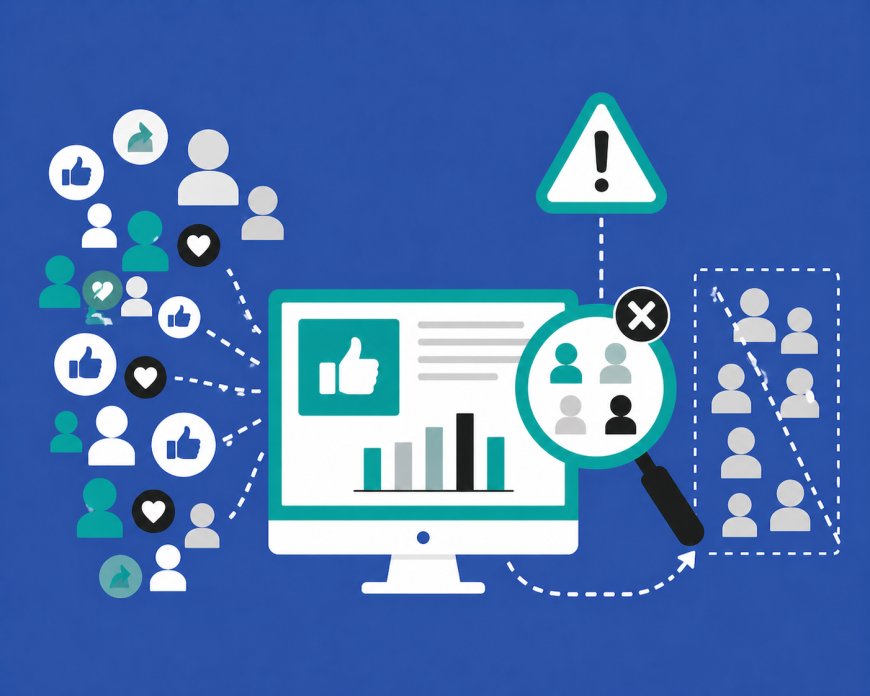
If the question is asked directly—can we trust surveys conducted through social media platforms such as Twitter, Facebook, or WhatsApp?—the answer, from a scientific standpoint, is clear: no.


This conclusion is not based on opinion, but on fundamental principles of scientific research, particularly those related to sampling, data quality, and methodological rigor. To understand why, one must first recognize that a survey is not simply a set of questions. It is a structured process designed to produce reliable, generalizable insights about a defined population. When this structure is violated, the results lose their validity, regardless of how large the number of responses appears.
The first and most critical issue lies in the definition of the sample. In any scientific study, the sample must be clearly identified and bounded. For example, a study may target adult women in a specific city, and further specify how these participants are reached—such as through a defined university or institution. This precision ensures that the data collected represents a known group, allowing conclusions to be interpreted within that context. Social media surveys eliminate this boundary entirely. Anyone, from anywhere, can participate. As a result, the researcher no longer knows who the data represents, and therefore cannot determine where the findings apply.
Closely related to this is the principle of replicability. A valid study must be designed in a way that allows other researchers to repeat it under the same conditions and verify its results. This requires a clearly defined sample and a controlled method of access. In social media surveys, neither condition exists. The audience is undefined, constantly changing, and influenced by algorithms and user behavior. Replication becomes impossible, and with it, the ability to confirm validity.
The second major issue concerns response rate, a key indicator of data quality. Response rate measures the proportion of individuals who participated in a study out of those who were invited. In structured research, this figure is known and controlled. For example, inviting 6,000 individuals and receiving 4,700 responses yields a response rate of approximately 75%, which is considered strong. On social media, however, the number of people who see a survey is unknown and often extremely large. If a survey link reaches hundreds of thousands or even millions of users, but only a small fraction respond, the response rate becomes negligible. A response rate of less than 1% is not a minor issue—it indicates severe sampling bias, where only a specific type of individual chooses to participate.
This leads to the third issue: non-response bias. In high-quality research, information about those who do not participate is either known or can be controlled. If a participant refuses, another individual with the same characteristics can be invited to maintain balance. This ensures that the sample remains representative. On social media, this process does not exist. There is no way to identify who did not respond, let alone replace them with equivalent participants. The resulting data reflects only those who chose to engage, not the broader population.
Perhaps the most critical flaw is the inability to verify participant identity. In controlled studies, whether conducted face-to-face or through structured systems, basic characteristics such as age, gender, and location can be validated. On social media, these attributes are assumed, not confirmed. A survey targeting a specific country may receive responses from entirely different regions. Experiments have shown that a significant portion of responses can originate from outside the intended population, sometimes from entirely unrelated countries.
This is not a minor deviation.
It invalidates the dataset entirely.
Because once the identity of participants cannot be trusted, the data loses its connection to reality.
Beyond these structural flaws, there is an additional risk that is often overlooked: manipulation. Open surveys on public platforms can be influenced intentionally. Groups or individuals may skew results, either for personal interest or to influence perception. In such cases, the data is not only unreliable—it may be deliberately misleading.
Taken together, these issues reveal a consistent pattern.
Social media surveys do not fail because of poor execution.
They fail because of their environment.
The platforms themselves are not designed for controlled sampling, verification, or methodological rigor. They are designed for reach, engagement, and speed—qualities that directly conflict with the requirements of scientific research.
This does not mean that social media has no role in research.
It can be used for awareness, recruitment under controlled conditions, or exploratory insights.
But it cannot replace structured sampling.
It cannot produce generalizable findings.
And it should never be used as a basis for critical decisions.
In the end, the danger is not in collecting data.
It is in believing it.
Because data without structure is not knowledge.
It is noise.
And decisions built on noise do not fail immediately—
they fail when it is too late to correct them.
What's Your Reaction?