




















































































The Replicability Crisis: Why Can't We Trust Scientific Findings?
The ""replicability crisis"" in science has led to retracted papers and a loss of trust. Learn about the root causes, from statistical bias to a lack of data transparency, and discover how new initiatives are addressing this critical issue.
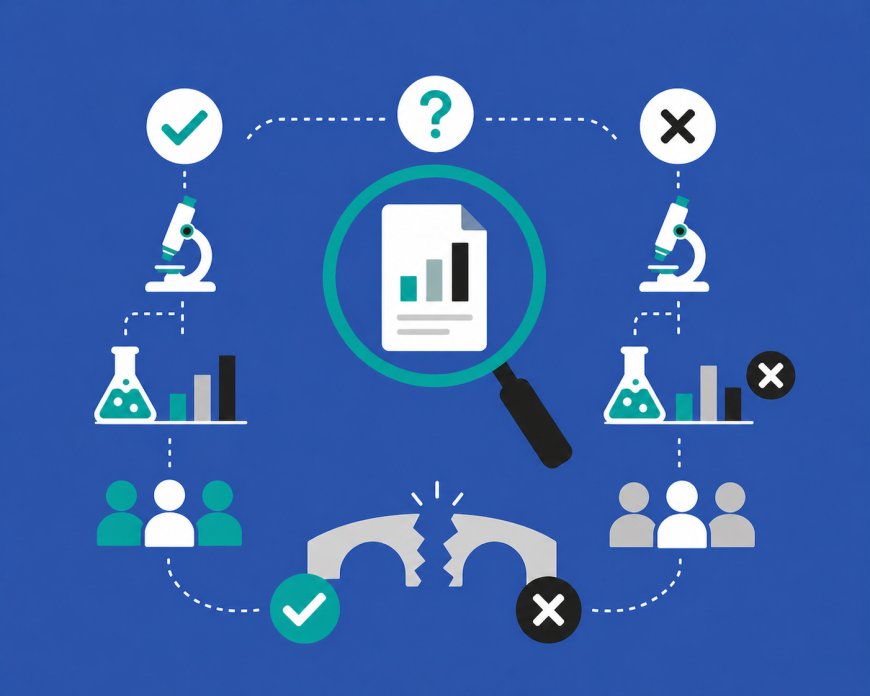
A scientific finding does not earn its credibility from its conclusion, but from the clarity of the path that led to it. Methodology is not a formal requirement. It is the core of scientific truth. When a study describes its procedures, assumptions, and analytical steps with precision, it enables others to follow the same path and arrive at the same destination. This ability—replication—is not an added value. It is the defining condition of reliable science.


Over the past decade, this condition has been challenged.
In 2010, The New York Times published a widely discussed article titled “The Truth Wears Off,” highlighting a pattern that had begun to concern the scientific community. Findings once considered robust appeared to weaken over time. Subsequent attempts to reproduce results, using the same methods, failed. This observation was not isolated. It triggered a wave of investigations, publications, and debates across disciplines, exposing what is now known as the replicability crisis.
At its surface, the issue appears technical.
At its core, it is structural.
A significant number of published studies—across fields such as psychology, medicine, and social sciences—cannot be replicated reliably. In some cases, papers have been retracted from leading journals after independent researchers failed to reproduce their results. These events have raised questions not only about specific findings, but about the systems that produce and validate them.
It is tempting to attribute this crisis to fraud.
But evidence suggests otherwise.
While instances of scientific misconduct do exist, they represent a minority. The more pervasive issue lies in methodological weakness and systemic incentives. Many studies are conducted under conditions that are not fully disclosed. Data collection processes may contain limitations, biases, or inconsistencies that are either underreported or overlooked. When these hidden variables are not accounted for, replication becomes difficult, even when the original researchers acted in good faith.
Another contributing factor is how results are presented.
Statistical significance has become a central criterion for publication. Studies that produce “positive” results—those that show significant effects—are more likely to be accepted by journals. This creates a bias in the literature, where negative or inconclusive findings remain unpublished. Over time, this selective visibility distorts the scientific record, presenting an incomplete picture of reality.
The pressure to publish amplifies this effect.
In many academic systems, a researcher’s success is measured by the number of papers produced, the journals in which they are published, and the citations they receive. These metrics prioritize quantity and visibility over robustness and long-term impact. As a result, researchers may unconsciously design studies, select methods, or interpret data in ways that increase the likelihood of publication, rather than the likelihood of replication.
The consequence is cumulative.
Each individual study may appear valid.
But collectively, the system becomes fragile.
Addressing this issue requires more than identifying its causes. It requires structural change in how science is conducted, evaluated, and supported.
One of the most critical interventions is the elevation of replication itself. Replication studies are often viewed as redundant, lacking novelty, and therefore receive limited funding and attention. This perception is flawed. Replication is not repetition. It is verification. It tests whether a finding holds under independent conditions, across different samples, and over time. Without it, scientific knowledge remains provisional, no matter how convincing it appears.
Increasing funding for replication studies is therefore essential. These studies should not compete with original research for recognition. They should be positioned as a complementary pillar, equally important in establishing evidence.
Transparency is another key component.
Many journals and publishers have begun to require researchers to share their datasets, analytical code, and detailed methodologies. This shift toward open science allows others to examine the underlying data, verify statistical procedures, and identify potential sources of error. While it does not guarantee replication, it reduces opacity and increases accountability.
In parallel, global data repositories have emerged, providing structured platforms for researchers to store and share raw data. These systems not only support verification, but also enable secondary analysis, extending the value of existing research.
At the national level, similar efforts are taking shape. In Saudi Arabia, the Saudi Health Council, through the National Center for Health Research, has established a centralized platform for sharing research data among researchers. This initiative reflects an understanding that data accessibility is a prerequisite for scientific integrity. While it is not a complete solution, it represents a critical step toward building a more transparent research ecosystem.
Ultimately, the replicability crisis is not a failure of science.
It is a reflection of its evolution.
As scientific systems expanded, the mechanisms for validation did not keep pace. What is being observed now is not the collapse of knowledge, but the exposure of its weaknesses. This exposure, if addressed correctly, strengthens the system rather than undermines it.
The path forward is clear.
Prioritize replication.
Reward transparency.
Redefine success metrics.
And recognize that the value of a scientific finding is not in how quickly it is published—
but in how reliably it endures.
What's Your Reaction?