

















































































The Quantum Nature of Work: Unpacking the Hidden Dynamics of Workplace Culture
This article examines the quantum-like behaviors of workplace culture, exploring the non-linear, entangled interactions within organizations. It challenges traditional models, advocating for a complex systems approach to understand and enhance workplace dynamics.

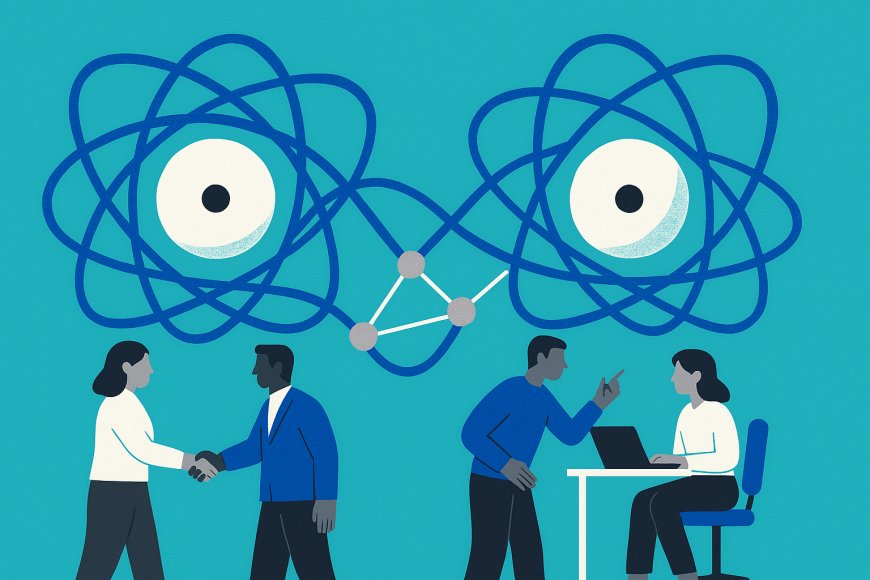
Consider an organization as a complex quantum system, where the seemingly mundane interactions among employees mirror the non-intuitive principles of quantum physics. Much like particles that exhibit dual behavior, employees navigate the workplace exhibiting roles defined by their titles and yet fluidly adapting to varying circumstances. This paradoxical nature of workplace culture raises intriguing questions: Can understanding the quantum-like behaviors of organizations illuminate the pathways to more harmonious and productive work environments?


The notion that workplace culture behaves in a quantum-like manner may seem abstract, yet it can be grounded in observable phenomena. In a typical organizational setting, an employee's behavior can shift dramatically in response to changes in context, akin to the way quantum particles change states. This raises the possibility that traditional hierarchical models fail to capture the dynamic complexity inherent in organizational life. Instead, a framework that embraces complexity and uncertainty may offer more robust insights into cultivating positive workplace cultures.
The Quantum Entanglement of Employee Interactions
In the quantum realm, entanglement refers to a peculiar relationship where particles become interconnected, such that the state of one instantly influences the other, irrespective of distance. Similarly, employees' interactions within an organization can be viewed as a network of entangled relationships, where actions or changes in one department can have immediate, unforeseen repercussions across the entire organizational fabric.
A hypothetical case study can illustrate this concept: Imagine a company where a restructuring in the finance department leads to a shift in the workload distribution. This change propagates through the organization, affecting teams in marketing and operations, altering their strategies and outputs. Traditional management theories may predict certain outcomes based on linear cause-and-effect assumptions. However, the actual impact often defies these predictions, reflecting the non-linear, entangled nature of employee relationships.
To better understand this phenomenon, consider the implementation of a new project management tool. In theory, such a tool should streamline workflows and enhance productivity. Yet, the introduction of this tool may lead to unintended consequences—creating bottlenecks in communication, altering team dynamics, or even fostering resistance among employees. This reflects the entangled complexity, where interactions and dependencies yield unexpected outcomes, challenging the conventional wisdom of straightforward organizational interventions.
Embracing the concept of entanglement within workplace culture requires a paradigm shift in management strategies. Leaders must recognize that fostering a cohesive and adaptive organizational culture involves more than enforcing rigid structures. It necessitates nurturing a collaborative environment where communication flows freely, and employees are empowered to adapt to changes dynamically.
Non-Linear Dynamics and Organizational Change
Organizations, like quantum systems, exhibit non-linear dynamics—a characteristic often overlooked in traditional models. These dynamics manifest in the unpredictable, sometimes chaotic responses to change initiatives within an organization. In practice, this means that small changes can produce disproportionately large effects, akin to the butterfly effect observed in complex systems.
Imagine an organization initiating a minor policy change, such as increasing the frequency of team meetings. While intended to enhance collaboration, this change might inadvertently lead to meeting fatigue, reducing productivity and morale. The non-linear nature of workplace dynamics suggests that outcomes are rarely straightforward, and minor adjustments can escalate into significant cultural shifts.
Further examination reveals that organizational resilience is deeply tied to the ability to navigate these non-linear dynamics. In a typical behavioral experiment, a company might test the effects of remote work policies on employee satisfaction and performance. Initial findings could suggest an increase in flexibility and work-life balance. Yet, over time, the lack of physical interaction could erode team cohesion, leading to challenges in communication and collaboration.
Recognizing these dynamics requires an appreciation for complexity rather than a reliance on simplistic, linear models. Leaders must adopt adaptive management styles that prioritize flexibility and responsiveness, allowing organizations to thrive amidst the unpredictable and often chaotic nature of workplace change.
The Observer Effect in Workplace Cultures
The observer effect, a well-documented quantum phenomenon, suggests that the act of measurement itself alters the state of the system being observed. In organizations, this is reflected in the way employee performance assessments, surveys, and evaluations can inadvertently influence behavior and perceptions, skewing the results they aim to measure.
Consider a scenario where a company introduces a performance evaluation system designed to enhance productivity. Employees, aware of being observed and measured, may alter their behavior to align with perceived expectations, potentially sacrificing authenticity and creativity. This phenomenon parallels the observer effect in quantum mechanics, where the act of observation influences the state of the system.
To mitigate this, organizations need to develop metrics and assessment strategies that minimize the observer effect. This involves creating a cultural environment where feedback is continuous and constructive, focusing on long-term development rather than immediate performance metrics. By doing so, organizations can cultivate a workplace culture that genuinely reflects employee capabilities and fosters sustainable growth.
The hidden dynamics of workplace culture reveal a complexity akin to the quantum world. Recognizing these parallels can inspire fresh approaches to managing and improving organizational environments. Just as quantum theory challenges classical assumptions, embracing these intricacies in workplace culture may lead to unexpected innovations, fostering adaptability and resilience in the ever-evolving world of work.
What's Your Reaction?