























































































Combating Food Waste: A Call for Change in Saudi Arabia
An analysis of food waste in Saudi Arabia, its financial and environmental impact, and a call for a change in consumer behavior, especially during Ramadan.
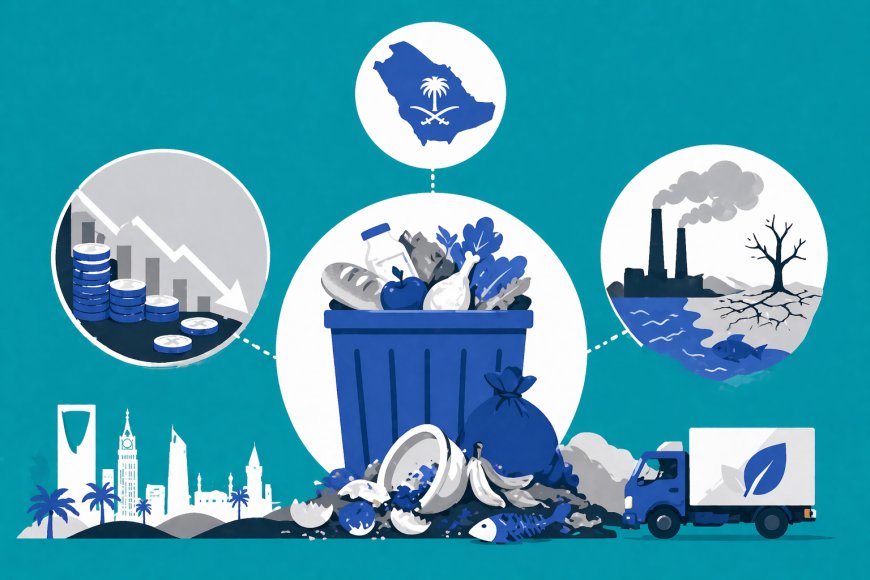
The term food waste refers to any disposal of food, whether raw or cooked, across the entire chain from harvesting to wholesale and retail distribution, and finally to household consumption. It is often framed as an economic issue, yet its implications extend far beyond cost. It intersects directly with survival, dignity, and global equity, at a time when millions still face hunger every day.


Around the world, approximately 811 million people go to bed hungry each night, while nearly one third of all food produced for human consumption is wasted. This imbalance reflects not scarcity, but mismanagement. The economic value of this waste exceeds one trillion US dollars annually, but its human cost is far greater.
Recognizing this, international organizations such as the United Nations, the Food and Agriculture Organization, and the World Food Program have placed food waste reduction at the center of global priorities. One of the key targets of the Sustainable Development Goals is to reduce per capita food waste by nearly half by the year 2030.
The local dimension
Within the Kingdom of Saudi Arabia, the scale of the issue is equally significant. Findings from local research indicate that waste rates reach approximately 45 percent for raw food, while disposal of cooked food rises to nearly 60 percent. National estimates place the annual value of food waste at around 40 billion Saudi riyals.
Patterns within the data reveal that waste is higher among younger individuals under the age of 30, more prevalent among women than men, and more concentrated in major urban centers such as Riyadh, the Eastern Province, and the Makkah region. Interestingly, income and education levels do not appear to significantly influence waste behavior, suggesting that the issue is cultural and behavioral rather than purely economic.
A scientific study published in 2021 established a baseline for measuring food waste at the individual and household level in the Kingdom. This work provides a foundation for decision-makers across sectors, including food security authorities, public health bodies, and logistics stakeholders, to better understand how demographic factors influence consumption patterns.
Ramadan: the paradox of abundance
The arrival of Ramadan brings a noticeable shift in consumption behavior. Each year, demand for food products increases significantly. Reports indicate that spending on food during Ramadan can equal that of three months combined, highlighting the scale of consumption during this period.
Yet this increase does not reflect need. It reflects excess.
Meals prepared for Iftar and Suhoor often exceed actual requirements, leading not only to higher levels of food waste but also to health consequences. Overconsumption of high calorie foods contributes to digestive disturbances, discomfort, and long term metabolic strain.
Beyond redistribution
Efforts to redistribute surplus food through charitable organizations play an important role, but they address the consequence rather than the cause.
The deeper question remains: why is excess prepared in the first place?
Producing more food than needed, only to redistribute or discard it, reflects a misalignment between intention and behavior. Even the practice of feeding surplus food to animals, often perceived as compassionate, carries environmental implications and does not resolve the underlying inefficiency.
Reframing consumption
Reducing food waste requires more than awareness campaigns. It requires a shift in how food is perceived and managed at the individual level.
Ramadan offers an opportunity for this shift. Not only in terms of diet or physical activity, but in restoring moderation. Consumption can be aligned with actual need, portions can be adjusted, and preparation can become intentional rather than habitual.
A principle of balance
The issue of food waste ultimately returns to a simple principle: balance.
Excess, even when driven by generosity or habit, carries consequences that extend beyond the individual. It affects resources, systems, and communities.
The challenge is not to eliminate abundance, but to manage it with awareness.
Because the measure of consumption is not how much is available, but how much is needed.
What's Your Reaction?