



















































































From Academic Crisis to Redefined University Value
As AI challenges traditional academic models, universities face a choice: collapse or redefine their value. This article explores how universities can transform from 'certificate factories' into economic powerhouses by embracing AI and focusing on applied, experience-based learning.
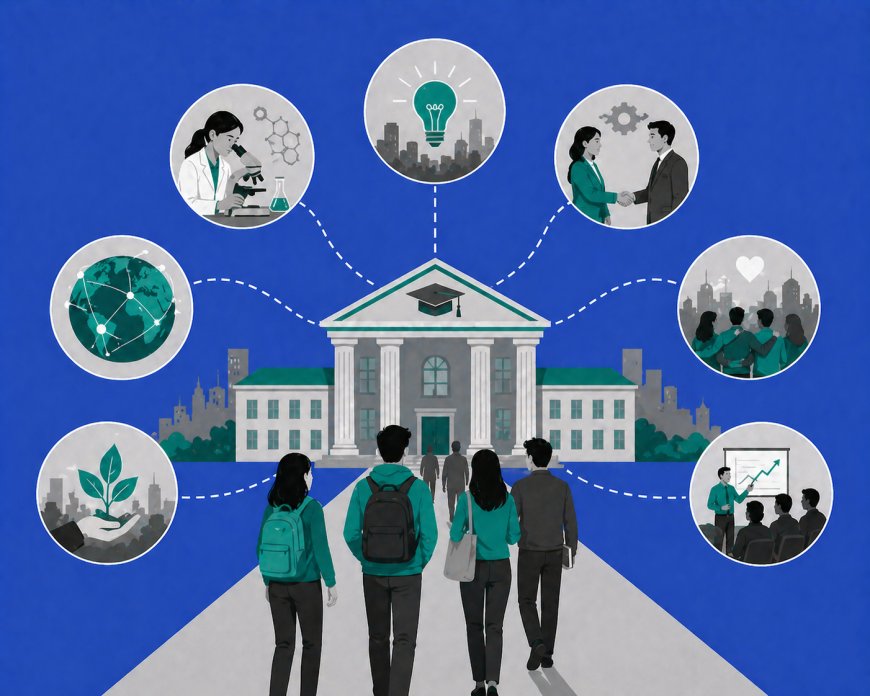
Universities today are standing at a point of tension they have not experienced for centuries, a moment where their existence is no longer assumed but questioned, not from the outside alone, but from within their own structure. For generations, the university represented the highest gateway to knowledge, the place where information was stored, organized, and delivered, and where individuals invested years of their lives to gain access to what could not be obtained elsewhere. But this equation has shifted fundamentally. Knowledge is no longer scarce. It is immediate, accessible, and increasingly automated. The emergence of advanced technologies capable of analyzing, summarizing, and even generating knowledge has not merely introduced a new tool into the academic environment; it has disrupted the foundation upon which the traditional university model was built.


This disruption exposes a central question that universities can no longer avoid: what is the value of an institution whose primary function was the transmission of knowledge, in a world where knowledge is no longer confined within its walls? The issue is not that universities have become irrelevant, but that their traditional function has. The model based on passive reception—where students attend lectures, absorb information, and are evaluated based on recall—no longer aligns with the reality of a world that values application over memorization and execution over accumulation.
For decades, universities operated within a closed system. Curricula were designed, repeated, and refined internally, often detached from the dynamic requirements of the external world. Students progressed through structured programs, believing that the completion of academic requirements would translate directly into professional readiness. Yet, upon entering the workforce, many encountered a different reality. The knowledge they acquired required reinterpretation, adaptation, and often replacement. The gap between academic preparation and practical demand became evident, not as an exception, but as a pattern.
This gap is not accidental. It is the result of a system that prioritized stability over adaptability, theory over application, and structure over responsiveness. In such a system, updating content becomes slow, experimentation becomes limited, and learning becomes repetitive. The institution continues to operate, but its connection to reality weakens. And when a system becomes detached from the environment it is meant to serve, it does not collapse immediately—it becomes gradually less relevant.
The comparison to other industries that faced similar disruption is instructive. When digital platforms emerged, traditional media institutions lost their monopoly over information. They were no longer the sole gatekeepers of content. Some adapted, transforming their models and redefining their role. Others resisted and declined. The same structural shift is now visible in education. The authority of the university as the primary source of knowledge has diminished. What remains is the question of what replaces that authority.
The answer lies not in resisting change, but in redefining value. If knowledge can be accessed instantly, then the role of the university cannot remain centered on delivering it. Instead, it must shift toward creating contexts where knowledge is used, tested, and transformed into capability. The future university is not a place where students go to receive information. It is a place where they engage with reality, build projects, solve problems, and develop the ability to operate within uncertainty.
This requires a structural transformation. The university must move from being a conveyor of content to becoming a platform for experience. Learning must extend beyond lectures into environments that simulate or directly connect with real-world conditions. Partnerships with industries, integration of projects into curricula, and exposure to practical challenges must become central, not supplementary. In such a model, the student is no longer a passive participant, but an active contributor.
At the same time, the measure of success must change. Traditional evaluation methods, which emphasize recall and standardized responses, fail to capture the complexity of real capability. Future systems must assess the ability to analyze, to apply, to create, and to adapt. These are not easily measured through conventional exams, but they are essential in a world where information alone is no longer a competitive advantage.
The implications extend beyond education into the structure of the economy itself. Universities that successfully transform will not remain purely educational institutions. They will evolve into centers of innovation, research, and economic activity. They will host startups, develop technologies, and participate directly in shaping industries. In this model, the boundary between education and production dissolves. The university becomes an active participant in the knowledge economy, not a preparatory stage for it.
Conversely, institutions that fail to adapt face a different trajectory. Their degrees may lose value as employers shift their focus toward demonstrated skill and real achievement. Their programs may become outdated as technology advances faster than curricula can be updated. And their role may be reduced to certification rather than transformation. This does not imply immediate disappearance, but gradual marginalization.
The critical distinction, therefore, is not between traditional and modern universities, but between those that redefine themselves and those that preserve outdated models. The future will not eliminate universities. It will differentiate them. Some will become central to the next phase of economic and intellectual development. Others will remain peripheral, maintaining form without function.
What is unfolding is not a temporary adjustment, but a redefinition of education itself. The question is no longer how universities can maintain their historical role, but how they can construct a new one. And the answer will determine not only their survival, but their relevance in a world where knowledge is abundant, but capability remains scarce.
In the end, the value of a university will not be measured by what it teaches, but by what it enables.
Not by the information it provides, but by the transformation it produces.
And the institutions that understand this shift will not merely survive the future.
They will define it.
What's Your Reaction?