





































































Rethinking Economic Growth: The Role of Complexity in Market Dynamics
This article investigates the intricate role of complexity in economic growth and market dynamics. Challenging traditional economic models, it explores how adaptive systems and complex interactions drive unpredictable yet impactful economic patterns.

In the vast tapestry of economic discourse, a fundamental question remains under continuous scrutiny: What truly drives economic growth? The conventional wisdom, deeply rooted in classical economic theory, often simplifies this intricate phenomenon into manageable equations and models. Yet, the reality of economic growth appears far more complex, shaped by dynamic systems that defy reductionist approaches.


Consider a scenario where a local market reacts to the introduction of a disruptive technology. At first glance, one might predict a straightforward trajectory of growth based on increased productivity and innovation. However, the real-world outcome often diverges significantly due to a multitude of interacting variables, including consumer behavior, regulatory changes, and unforeseen supply chain adjustments. The traditional models of economic growth, which rely heavily on assumptions of equilibrium and rational actors, often fall short in capturing these subtleties.
The Complexity Framework in Economic Modeling
Traditional economic models frequently operate under the assumption of linear interactions and predictable responses. These models simplify the economy into equations where inputs and outputs are clearly defined and quantifiable. Yet, this approach often neglects the inherent complexity present in actual economic systems. An alternative framework, drawing from theories of complexity sciences, offers a more nuanced perspective.
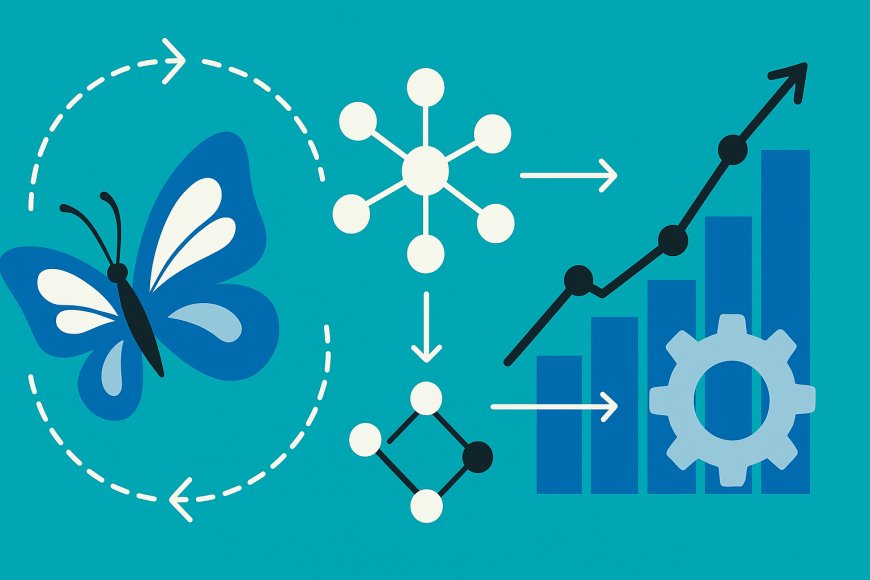
In a typical observational study employing complexity theory, economists might examine how small, seemingly insignificant changes in consumer preferences can lead to disproportionate effects on market trends. This phenomenon, often referred to as the "butterfly effect," highlights the sensitivity of economic systems to initial conditions. A slight shift in consumer sentiment regarding sustainability, for example, can rapidly propagate through supply chains, influencing production methods, impacting global trade policies, and eventually altering macroeconomic indicators.
Complexity frameworks also emphasize the importance of adaptability in economic systems. Markets are not static entities but are continuously evolving as participants learn and adapt to new information. In complex adaptive systems, such as financial markets, agents (individuals, firms, institutions) continuously adjust their strategies based on the perceived actions of others. This scenario creates feedback loops that often lead to emergent properties, such as market bubbles or crashes, which are not predictable through traditional linear models.
Adaptive Systems and Their Economic Implications
Adaptive systems theory provides powerful insights into the dynamic nature of economic growth. These systems are characterized by constant feedback and adaptation, where agents modify their behavior in response to changes in their environment. In economic contexts, this means acknowledging that markets and economies are perpetually in a state of flux, driven by the evolving strategies and expectations of their participants.
Consider a behavioral experiment where firms in a competitive market are exposed to a new regulatory policy aimed at reducing carbon emissions. Initial reactions may vary significantly—some companies might invest heavily in clean technology, while others might lobby for regulatory change. Over time, these strategies influence the market landscape, creating new leaders and dissolving former giants, all without a clear, predictable path leading to economic growth.
By understanding markets as adaptive systems, economists can better capture the non-linear interactions and emergent phenomena that define complex economies. This perspective shifts the focus from static predictions of growth rates to dynamic analyses of how economies adjust and reorganize in response to internal and external pressures. It suggests that economic growth should be viewed less as a steady upward trajectory and more as a series of adaptive cycles, each characterized by phases of growth, stability, and potential disruption.
Challenging Established Economic Assumptions
The application of complexity and adaptive systems theories to economic growth challenges several established assumptions. For instance, traditional models often emphasize the role of capital accumulation and technological advancement as primary drivers of growth. While these factors remain important, a complexity perspective reveals that their impact is mediated by a host of interacting variables that can alter expected outcomes.
In a hypothetical case study, an economy heavily reliant on manufacturing might experience unexpected growth spurts not from increased production but from the innovative integration of digital services into their supply chains. This shift could be driven by a network of small firms leveraging digital platforms to enhance efficiency and reach new markets, thus demonstrating the power of complex interactions over simplistic linear growth paradigms.
Moreover, complexity theories underscore the limitations of relying solely on equilibrium models in economic forecasting. Real-world economies often operate far from equilibrium, characterized by constant fluctuations and adjustments. Recognizing these dynamics allows policymakers to design more resilient strategies that account for uncertainty and change, rather than seeking to maintain a potentially unsustainable status quo.
As researchers continue to explore the multifaceted nature of economic systems, the integration of complexity science into economic theory promises to yield insights that are both profound and practical. It invites a rethinking of how we approach economic growth, challenging the status quo and embracing the unpredictable yet deeply interconnected nature of global economies.
The future of economic inquiry lies in acknowledging and harnessing the complexity of market dynamics. By shifting the focus from simplistic models to adaptive systems, we pave the way for a more resilient understanding of growth. This approach not only enriches academic discourse but also equips policymakers with the tools to navigate the intricacies of modern economies, ultimately fostering sustainable development in an ever-evolving global landscape.
What's Your Reaction?