The Philosophical and Psychological Crisis of Resisting Change
A deep dive into why professors are so angry about generative AI. This article explores the philosophical and psychological crisis of resisting change, revealing how it stems from a fear of losing prestige and the disruption of traditional academic roles.
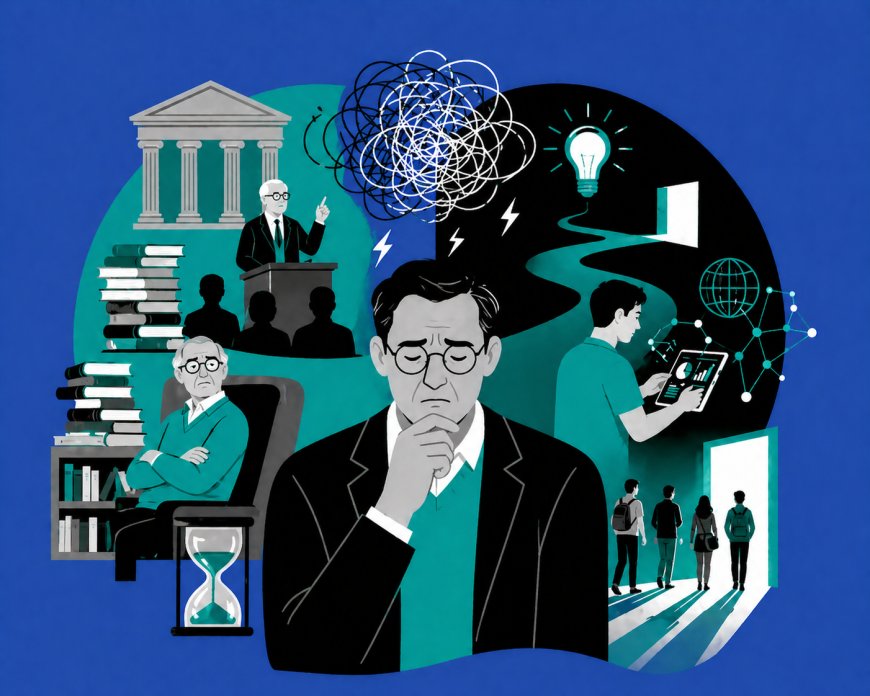
At the beginning of each academic year, a familiar scene begins to circulate across universities worldwide. Professors expressing visible frustration, sometimes even anger, not because students are failing, but because they are succeeding differently. Students are using generative AI tools to summarize lectures, solve assignments, and answer complex questions with speed and accuracy that were previously unimaginable. On the surface, the reaction appears to be about academic integrity or the fear of shortcuts. But beneath this reaction lies something deeper, more structural, and more unsettling. It is not a conflict with technology. It is a conflict with identity.


For decades, the academic system was built on a specific hierarchy of knowledge. The professor was the central authority, not only because of what he knew, but because of how he accessed what he knew. Knowledge was scarce. Information required effort, time, and skill to obtain. A researcher would spend hours navigating libraries, analyzing texts, filtering sources, and constructing understanding through a process that was as demanding as it was defining. These efforts were not merely technical steps; they became part of the academic identity itself. The ability to search, retrieve, and organize knowledge became a marker of competence, a way to distinguish the expert from the novice.
Then, in a remarkably short period, this structure shifted.
AI systems emerged that could perform many of these tasks instantly. What once required hours now takes seconds. A student can ask a question and receive a structured, refined, and often accurate response. He can request simplification, comparison, expansion, or even transformation of the information into different formats. The barrier to access has effectively disappeared.
This is not a small technological improvement.
It is a fundamental redefinition of the relationship between humans and knowledge.
And it is precisely this shift that creates discomfort within the academic system.
The traditional academic mind was shaped in an environment where access to knowledge was the primary challenge. Today, access is no longer the problem. The problem has shifted to understanding, interpreting, and applying knowledge. This should have been the natural evolution of education. Yet, instead of embracing this transition, many academics resist it. The reason is not purely intellectual. It is psychological.
The role they mastered is dissolving.
When the student can access the same information, sometimes more efficiently, the professor is no longer the gatekeeper. The authority that once came from controlling access is reduced. And for those who built their identity around that role, the shift feels like a loss, not an opportunity.
This is where the reaction intensifies.
The rejection of AI is often framed as a defense of academic standards. But in many cases, it reflects a deeper fear: the fear of becoming irrelevant. When a system changes faster than the individuals within it can adapt, it exposes gaps that were previously hidden. A professor who relied on the ability to retrieve and present information now faces a new question: what value do I provide beyond what a machine can deliver?
This question is not comfortable.
Because it demands a redefinition of purpose.
The true value of a professor was never meant to be the transmission of information. It was meant to be the transformation of understanding. To interpret, critique, connect, and challenge. To place knowledge within a broader intellectual framework. To guide students not in finding answers, but in questioning them. But when the system for years rewarded the simpler role—delivering information—many did not develop the deeper one.
AI does not create this weakness.
It reveals it.
And this is why the reaction is emotional.
It is not about the tool itself.
It is about what the tool exposes.
The classroom is no longer a space where knowledge flows in one direction. The student now arrives equipped with tools that can match, and sometimes exceed, the informational capacity of the professor. This creates a redistribution of intellectual power. The professor is no longer the sole source. He becomes part of a system where knowledge is shared, challenged, and expanded collaboratively.
This transition can lead in two directions.
The first is resistance. Attempting to restrict the use of AI, to maintain control, to preserve the old structure. This path may provide temporary stability, but it does not solve the underlying issue. It delays adaptation while the external environment continues to evolve.
The second is transformation.
Recognizing that AI removes the burden of access, allowing education to focus on what truly matters. Interpretation, critical thinking, synthesis, and application. The professor is no longer required to spend time delivering what can be accessed instantly. Instead, he can operate at a higher level—guiding students through complexity, challenging assumptions, and developing intellectual independence.
This is not a reduction of the professor’s role.
It is an elevation of it.
But elevation requires change.
It requires abandoning the comfort of old skills and building new ones. It requires shifting from authority based on possession of knowledge to authority based on depth of understanding. It requires accepting that the student is no longer dependent, but empowered.
The question is not whether this change will happen.
It already has.
The question is whether academics will adapt to it or resist it.
Because the system will not wait.
Students will continue to use the tools available to them. Knowledge will continue to become more accessible. And the gap between those who evolve and those who resist will widen.
In the end, this is not a technological crisis.
It is a philosophical one.
A question about what it means to teach, to learn, and to hold authority in a world where knowledge is no longer scarce.
And those who answer this question correctly will not lose their role.
They will redefine it.
What's Your Reaction?