The Psychological Crisis of Hesitation: Why We Fear Making a Decision
This article provides a psychological analysis of hesitation, revealing it as a disguised fear of responsibility and a deep-seated contradiction between our projected identity and our true selves. It explores how social environments can program us to avoid making decisions and offers a path to healing this behavior.
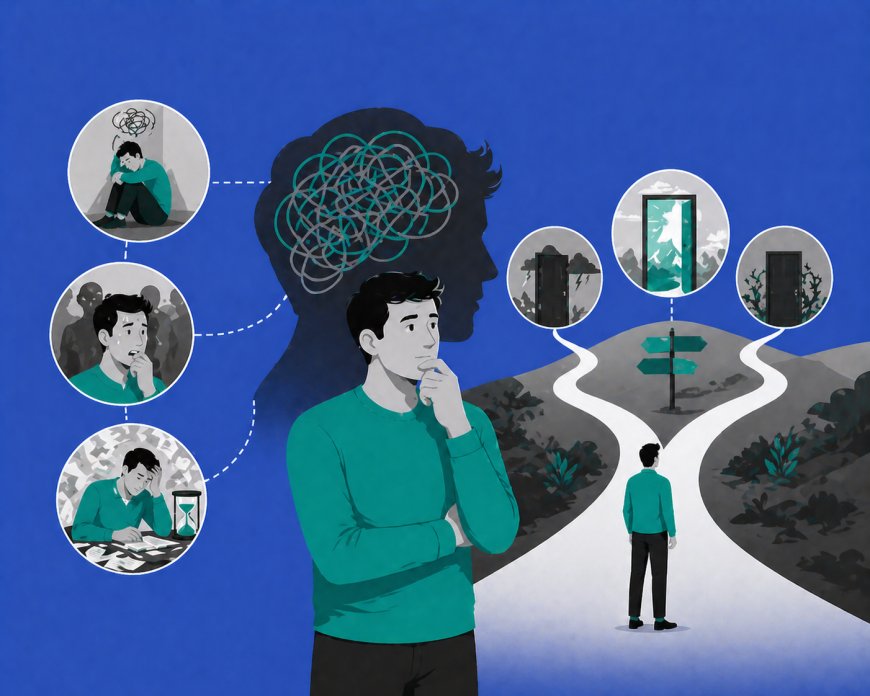
There is a moment that appears neutral but is anything but neutral, a moment where a person neither advances nor retreats, where he suspends himself in a gray space and calls it thinking, reflection, or caution. Yet beneath this apparent stillness lies a concealed act, a decision not to decide. This position, often disguised as wisdom, is in reality one of the most decisive responses to life. Because to remain still when movement is required is not the absence of action, but a silent commitment to delay, and delay carries consequences no less real than error.


Hesitation is rarely about the surface reasons we give it. It is not simply fear of making a mistake, nor is it always a lack of information. Beneath it lies something deeper, more structural. It is the fear of exposure. The fear that the decision will not only produce an outcome, but reveal something about us that we have spent years hiding. Many individuals construct an identity around themselves, an image of competence, intelligence, or leadership, and when the moment of real decision arrives, this image is tested. Not in theory, but in action. And action has a cruel honesty. It reveals gaps that words can hide. It exposes the difference between what we claim and what we can actually carry. In that moment, hesitation becomes a shield, not against the result, but against the collapse of the image.
This explains why some of the most hesitant individuals are not the least informed, but the most performative. They have trained themselves to speak, to appear, to convince, but not to act. Their knowledge exists in language, not in execution. And when reality demands a decision, language fails. What remains is silence disguised as delay, analysis extended beyond necessity, and a search for more time that is less about clarity and more about avoidance.
There is also another layer that intensifies this condition, one that is not personal alone, but social. Hesitation is not always born within the individual. It is often cultivated. From early stages, many are raised not to confront uncertainty, but to protect an inflated image of themselves. Praise is given not for effort, but for imagined superiority. A child is told he is exceptional before he has struggled, that he understands everything before he has failed, that he is ahead before he has been tested. This creates a fragile self, one that cannot tolerate error, because error is not seen as a step, but as a threat. And when such a self is faced with real decisions, it freezes. Not because it does not know, but because it is not allowed not to know.
This fragility is reinforced further by environments that reward appearance over substance. In many systems, value is attached to voice rather than action, to presence rather than outcome. The ability to speak, to present, to be seen, becomes a substitute for the ability to execute. And in such an environment, hesitation becomes logical. Why risk exposure through decision, when status can be maintained through speech? Why carry responsibility, when perception is enough?
Thus, hesitation evolves from a moment into a stance. A way of being. A strategy of survival.
But survival through hesitation is costly. It consumes more energy than decision itself. It prolongs uncertainty, drains focus, and erodes confidence. Opportunities do not wait for clarity. Time does not pause for indecision. And what begins as caution becomes stagnation. The most dangerous aspect is that the person remains unaware of this cost, because it accumulates slowly, without a single moment that signals loss.
To move beyond this state, the solution does not begin with better analysis, but with honesty. The first step is to admit that hesitation is not always wisdom. That in many cases, it is a weakness in the structure of the self. A refusal to carry responsibility, to accept imperfection, to risk being wrong. This admission is difficult, because it dismantles the narrative of being thoughtful, careful, or strategic. But without it, no change is possible.
From there, a deeper reconstruction becomes necessary. A person must rebuild his relationship with decision itself. Not as a final judgment that defines him, but as a process that develops him. A decision is not a declaration of perfection. It is an act of movement. It is a way of interacting with reality, learning from it, and adjusting accordingly. Without decisions, there is no feedback. Without feedback, there is no growth.
This is where values become essential. A decisive person is not one who always knows the right answer, but one who has a stable internal compass. When values are clear, decisions become simpler. Not easier, but clearer. The person knows what he stands for, what he prioritizes, what he refuses, and what he accepts. In the absence of this clarity, decisions become reactions, shaped by fear, pressure, or the desire to please others.
Building this clarity requires discipline. It requires asking uncomfortable questions: What do I want, independent of expectation? What am I avoiding, and why? What will I lose if I do not decide? These questions are not theoretical. They are confrontational. They force the person to see the cost of hesitation not as safety, but as silent loss.
With time, decisiveness becomes less about single moments and more about accumulated practice. It is built through small choices, repeated consistently. Saying no when necessary. Choosing a direction without full certainty. Accepting outcomes without justification. Correcting mistakes without collapse. Each decision strengthens a psychological structure that says: I can carry what comes after my choice.
This is how hesitation transforms.
Not through one bold act, but through continuous engagement.
From avoiding decisions to owning them.
From protecting an image to building a self.
And eventually, from fear to sovereignty.
Because in the end, the most decisive shift is not external.
It is internal.
It is the moment a person stops asking, “What if I am wrong?”
And begins asking, “What happens if I never decide?”
What's Your Reaction?