


















































































Entropy in Biological Networks: Information Theory’s Insights into Cellular Communication
This article explores the role of entropy and information theory in understanding cellular communication within biological networks. By examining how cells process information and manage uncertainty, we gain insights into complex biological systems.

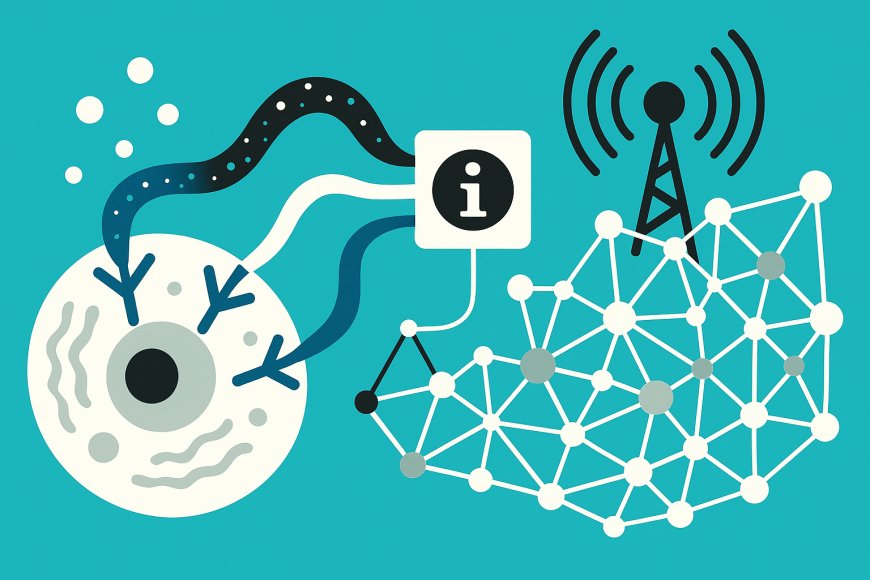
Cells are not isolated entities. They exist as part of a larger biological network, continuously processing information and responding to their environment. This intricate process of cellular communication is not merely a biochemical interaction but a sophisticated exchange of information. The concept of entropy, borrowed from information theory, provides a compelling framework to analyze how cells manage uncertainty and optimize communication within biological networks.


Entropy, often associated with disorder, plays a critical role in the efficient transmission of information within biological systems. A surprising aspect of cellular communication is its reliance on noise—traditionally seen as a hindrance to accurate information transfer. In a study involving neuronal cells, researchers observed that noise, in fact, contributes to redundancy, allowing for error correction and resilience in signal transmission. This phenomenon is akin to the error-correcting codes in digital communication systems, where redundancy is a means to ensure message integrity despite possible disturbances.
Entropy and Information Transfer in Cellular Networks
In a hypothetical experiment focusing on cellular networks, consider a setup where cells communicate via signaling molecules in a controlled environment. The system measures the entropy of signals emitted by sender cells and received by target cells. As the experiment progresses, it becomes evident that higher entropy in the signals corresponds to a more robust communication system. This robustness is not coincidental but rather a necessity for maintaining reliable information transfer in fluctuating environments.
Entropy serves as a measure of uncertainty and diversity in these signaling pathways. High entropy implies a wide variety of possible signaling states, which can be crucial for cells to adapt to environmental changes. For instance, in a bacterial colony responding to nutrient availability, the diversity of signaling pathways allows for a collective decision-making process, ensuring survival under varying conditions. The concept of entropy in this context mirrors its use in thermodynamics—systems naturally progress towards states of higher entropy, suggesting a preference for diversity and adaptability.
Moreover, the interplay of entropy and fidelity in cellular communication mirrors principles in synthetic data transmission systems. In digital networks, maximizing entropy can enhance the capacity and efficiency of information transfer. Similarly, in cellular systems, optimizing entropy can facilitate the robustness needed to counteract the noise and variability inherent in biological environments. This balance between entropy and fidelity represents a fundamental principle in both biological and artificial communication systems.
The Role of Redundancy and Noise
Redundancy in cellular signaling is akin to a safety net, ensuring that essential messages are conveyed accurately even in the presence of noise. In biological terms, noise refers to the stochastic variations in signaling molecule concentrations, receptor availability, or other cellular parameters. Far from being detrimental, this noise introduces redundancy, which paradoxically enhances the reliability of the communication network.
For example, in an observational study on hormone signaling in plants, researchers observed that noise-induced redundancy played a crucial role in mitigating the effects of environmental stressors. When exposed to unpredictable changes, plants demonstrated enhanced resilience due to their ability to rely on multiple redundant signaling pathways. This redundancy not only ensures survival but also optimizes resource allocation, a crucial factor in competitive ecosystems.
Noise and redundancy also highlight a deeper connection between entropy and biological evolution. Evolution favors organisms capable of effective information processing, as these systems can better adapt to changing environments. The presence of noise may initially appear as a barrier to clear communication, but it ultimately acts as a catalyst for evolutionary innovation, encouraging diversity and adaptability.
Implications for Understanding Complex Biological Systems
Information theory and entropy offer profound insights into understanding biological complexity. These concepts illuminate how cells and organisms navigate the seemingly chaotic landscapes of their environments. By embracing uncertainty and leveraging entropy, biological networks can achieve a delicate balance between stability and adaptability.
Consider the case of immune cells responding to pathogens. In a simulated scenario, immune cells face a barrage of signals and must discern friend from foe amidst the noise. Entropy, in this context, enhances the system's capacity to process diverse signals, improving the immune response efficiency. This adaptability is not only a testament to evolutionary complexity but also a potential avenue for bioengineering robust synthetic systems.
The exploration of entropy in cellular networks exemplifies the intricate dance between order and chaos that defines life. By applying information theory, we can decode the complexity of cellular communication, revealing a blueprint for designing adaptive, resilient biological and artificial systems.
In a future where interdisciplinary approaches integrate principles from information theory into biological research, the potential to innovate and enhance our understanding of life is immense. By deciphering the language of cells through the lens of entropy, we not only unravel the mysteries of life's complexity but also open new pathways for scientific discovery and technological advancement.
What's Your Reaction?