























































































The Quantum Mechanisms Underlying Investment Decision-Making: A Novel Perspective
This article delves into the role of quantum mechanics in understanding investment decision-making. By examining experimental setups and theoretical models, it explores how quantum principles may provide insights into the complexities of financial behavior and market dynamics.

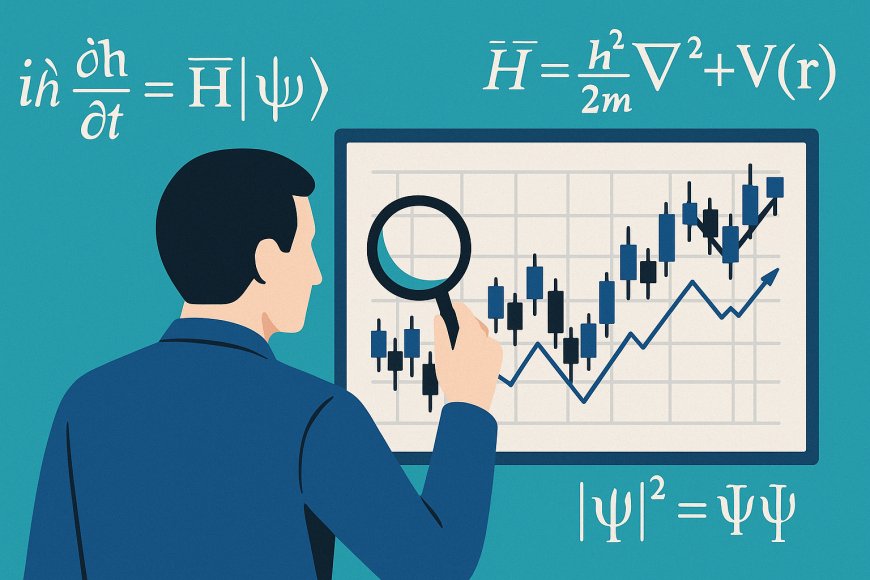
In a financial market, fluctuations appear chaotic and unpredictable. Yet, beneath this clamor, there might exist a subtle order akin to the quantum phenomena that underpin the smallest scales of reality. Quantum mechanics, traditionally confined to physical sciences, could provide a new lens to examine investment decision-making processes.


Consider an investor facing an array of stocks. Conventionally, they might rely on a deterministic approach, calculating expected returns, risk metrics, and other quantifiable data. But what if their decision-making process mirrors the non-deterministic nature of quantum particles? This possibility suggests a novel avenue for understanding financial behavior, one that incorporates the probabilistic essence of quantum mechanics.
Quantum Cognition in Investment Choices
The concept of quantum cognition posits that cognitive processes, such as decision-making, can be modeled using the mathematical framework of quantum mechanics. This theory challenges classical approaches by emphasizing superposition and entanglement in cognitive states. In typical stock market scenarios, investors might exhibit behavior that aligns with quantum superposition, representing simultaneous consideration of multiple investment strategies.
For instance, in an experimental setup where investors select between high-risk and low-risk stocks, traditional models predict a binary choice based on expected utility. However, quantum cognitive models suggest that the investor may hold a superposed mental state. This state involves both choices until an observation—or decision—collapses the state into one of the two outcomes.
Additionally, the concept of entanglement can apply to investors whose decisions are not isolated but influenced by market sentiment or peer behavior. Consider two investors influenced by a major economic event. Their subsequent decisions might become entangled, leading to correlated actions despite individual differences in risk tolerance or investment goals.
This quantum perspective aligns with behavioral finance, which studies psychological influences on market participants. While traditional models often fail to account for irrationality and biases, quantum cognition accommodates these nuances by allowing for probabilistic decision paths.
The Quantum Probability of Market Dynamics
Market dynamics often defy classical predictions. Price movements arise not only from logical evaluations but also from collective behavior patterns that resemble quantum fields. Here, the use of quantum probability theory may elucidate phenomena like market bubbles or crashes, where aggregate behavior supersedes rational forecasts.
In a typical observational study, researchers might analyze past market crashes. Classical probability theories would attribute these events to singular causes, whereas quantum probability accounts for the emergent properties of market interactions. This approach reflects the non-local and contextual dependencies evident in quantum fields, suggesting markets as complex systems with interdependent, probabilistic components.
In practical terms, quantum-inspired models could redefine risk management. By incorporating quantum probabilities, financial analysts could develop models that reflect potential states of the market rather than deterministic forecasts. This shift could lead to more agile strategies in investment portfolios, accommodating the inherent uncertainty and complexity of financial markets.
Moreover, quantum probability provides a framework for understanding investor sentiment's role in market dynamics. Sentiment, akin to quantum states, is inherently volatile and contextual, influencing the price mechanisms in ways that classical models struggle to predict. This insight introduces a dynamic component to market analysis, reflecting the fluidity and interconnectedness of investor decisions.
Neuroeconomic Insights through Quantum Mechanics
Neuroeconomics, which fuses neuroscience, psychology, and economic theory, offers a fascinating laboratory for testing quantum mechanics' applicability in finance. By observing neural activity during investment decisions, researchers can explore the parallels between brain processes and quantum systems.
Consider a behavioral experiment where participants undergo functional MRI scans while making investment choices. The neural data reveal patterns of activation that deviate from classical economic predictions. Instead, these patterns exhibit entanglement-like correlations, where neural circuits across diverse brain regions synchronize, influencing decision outcomes in non-linear ways.
This insight suggests that quantum mechanics might illuminate the neurological substrates of decision-making, enriching our understanding of financial behavior. For instance, the brain's capability to process information in a non-sequential, overlapping manner closely resembles the quantum principle of superposition, where multiple cognitive states coexist until a decision is reached.
Similarly, the brain's response to financial stimuli could mirror quantum tunneling, where cognitive processes bypass conventional decision pathways during moments of uncertainty. This tunneling might explain impulsive investor behavior during volatile market conditions, offering a new framework for interpreting seemingly irrational financial actions.
Ultimately, the integration of quantum mechanics into neuroeconomics could yield innovative investment strategies and risk assessment methodologies. This interdisciplinary approach invites a reconceptualization of financial markets, recognizing them as complex, adaptive systems akin to quantum networks in nature.
As we consider the future, the potential fusion of quantum mechanics with investment decision-making carries profound implications. By unveiling the probabilistic nature of cognition and market dynamics, we might better anticipate and navigate financial complexities. This nascent field promises to transform not only theoretical models but also practical approaches to investing, offering a sophisticated understanding of the interplay between human behavior and financial systems.
What's Your Reaction?