























































































The Obesity Crisis in Saudi Arabia: Trends, Costs, and Cultural Factors
An in-depth analysis of obesity trends in Saudi Arabia, its economic and health costs, and the societal factors contributing to the crisis.
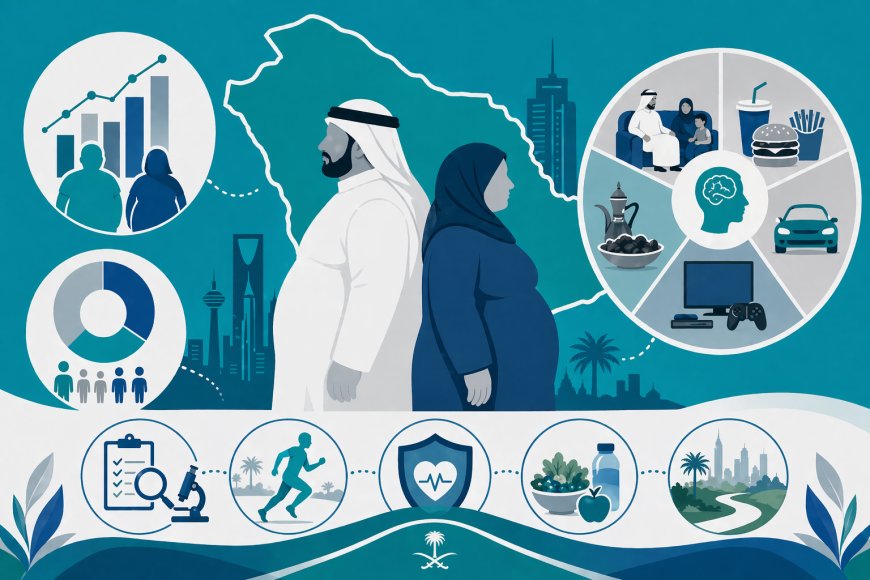
The conversation around obesity in Saudi Arabia has moved beyond individual responsibility into a broader, more complex terrain where health, economy, and culture intersect. What appears on the surface as a stable trend hides a deeper structural challenge that continues to evolve beneath the numbers.


Stability is not recovery
A slight decline in obesity rates may suggest progress, but it does not necessarily reflect a true shift in health outcomes. Stability, in this context, can coexist with persistent risk.
Chronic conditions linked to obesity continue to exert pressure on the healthcare system. The issue is no longer whether obesity is increasing or decreasing, but how deeply it is embedded in daily life.
Beyond the number on the scale
Reducing obesity to body weight alone overlooks its true nature.
It is a reflection of lifestyle patterns shaped by:
- Physical inactivity
- Dietary habits
- Psychological states
- Social and environmental conditions
When these factors align in an unhealthy direction, obesity becomes a predictable outcome rather than an isolated event.
The behavioral gap
Data indicates a widening gap between awareness and behavior.
High percentages of individuals remain below recommended physical activity levels, despite increasing exposure to health messaging. Similarly, inadequate dietary patterns persist, particularly in low fruit consumption and high intake of processed foods.
This suggests that information alone is insufficient. Behavior does not change simply because knowledge exists.
The economic dimension
Obesity carries a financial cost that extends beyond healthcare.
Increased rates of chronic disease lead to higher medical expenditure. At the same time, productivity is affected through increased absenteeism and reduced work capacity.
The burden is distributed across systems, not confined to individuals.
The environment shapes the outcome
Urbanization has redefined movement.
Daily life now minimizes physical effort through reliance on cars, automated services, and sedentary work environments. Physical activity is no longer embedded in routine; it has to be deliberately inserted.
At the same time, the food environment has shifted.
Highly processed, calorie dense foods are more accessible, more convenient, and often more appealing. Traditional dietary patterns have been gradually replaced, not by necessity, but by availability and design.
The psychological layer
Obesity is also linked to mental health.
The relationship is bidirectional. Psychological distress can influence eating behavior and activity levels, while obesity itself can contribute to emotional strain.
This interaction creates a reinforcing cycle that cannot be addressed through physical interventions alone.
Policy is necessary, but not sufficient
National initiatives, regulatory measures, and awareness campaigns are important steps. However, their impact is limited if they do not translate into daily behavioral change.
Sustainable progress requires alignment between:
- Policy frameworks
- Environmental design
- Cultural norms
- Individual behavior
Without this alignment, interventions remain fragmented.
The real question
The challenge is not only to reduce obesity rates, but to reshape the system that produces them.
Health is not determined at a single point of intervention. It is distributed across everyday decisions, environments, and constraints.
If those conditions remain unchanged, outcomes will tend to persist.
The question, then, is not whether change is possible, but whether the willingness exists to move beyond short term solutions toward structural transformation.
Because obesity, in this context, is not simply a medical condition. It is a signal.
What's Your Reaction?