The Knowledge Economy: A Three-Dimensional System of Power
Challenge the myth that a knowledge economy begins with scientific research. This article reveals it as a three-dimensional system: developing discovery methodologies, producing new knowledge, and transforming it into economic applications, with only a few nations controlling the first, most powerful phase.
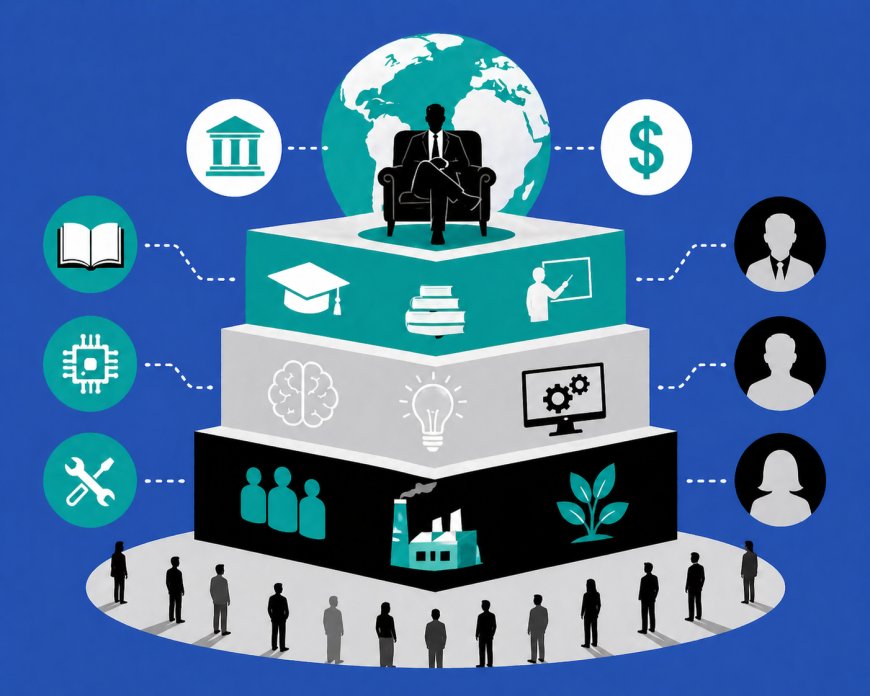
There is a persistent illusion in both academic and economic discourse that the path to a knowledge economy is straightforward: invest in education, increase research funding, encourage innovation, and progress will follow. Yet reality presents a contradiction that cannot be ignored. Many nations allocate vast resources to education and research, yet fail to produce knowledge of global influence. At the same time, a small number of countries dominate the returns of the knowledge economy, shaping not only discoveries but the very structure of how knowledge is generated and applied. This contradiction reveals a deeper truth: the knowledge economy is not a single stage. It is a layered system, and misunderstanding its sequence leads to structural failure.


At its core, the knowledge economy operates through three interconnected phases. The first, and most critical, is the development of discovery methodologies. This phase is often invisible, yet it determines everything that follows. It is not about producing information, but about designing the systems through which information is discovered, validated, and interpreted. Nations that control this phase do not merely participate in science; they define it. They determine what counts as evidence, how data is analyzed, and which questions are considered legitimate. This is the deepest form of intellectual power, and it is concentrated in a very small number of countries globally.
Most nations remain outside this phase without fully realizing its importance. They adopt existing methodologies as fixed frameworks, applying them to local problems without questioning their suitability. Research designs, analytical tools, and theoretical models are imported and used as if they were universal truths. In doing so, these nations limit their ability to generate original knowledge, because they operate within intellectual systems they did not create. The result is dependency—not only on technology, but on the logic that produces knowledge itself.
Once a nation possesses the ability to develop its own methodologies, it enters the second phase: producing new knowledge. This stage is often mistaken as the starting point, but it is in fact a consequence of the first. When the tools of discovery are controlled, the production of knowledge becomes a natural extension. Nations can explore new questions, design experiments aligned with their realities, and generate insights that are not constrained by external frameworks. However, timing becomes critical. Knowledge production is not a neutral process. It is competitive. Those who enter early define the landscape, while those who enter later are left to explore what remains.
The development of artificial intelligence provides a clear example. Nations that created the foundational methodologies—such as deep learning architectures and advanced computational models—were able to lead the field. They did not simply apply existing tools; they built them. As a result, they captured both the intellectual and economic value of the field. Other nations, despite adopting these technologies, remain in a position of application rather than leadership. They use what has already been created, but they do not define its future.
The third phase is the transformation of knowledge into economic application. This is the most visible stage, where research is translated into products, services, and industries. It is also the most misunderstood. Many nations attempt to start here, believing that entrepreneurship and innovation alone are sufficient to build a knowledge economy. While this approach can generate economic activity, it does not create independence. Without control over methodologies and original knowledge production, these economies remain dependent on external sources. They grow, but within boundaries set by others.
This misalignment explains why some nations struggle despite significant investment. The issue is not the lack of effort, but the sequence of action. Nations that focus only on application skip the foundational stages. Those that produce research without developing methodologies remain partially dependent. Only those that integrate all three phases—methodology, knowledge production, and application—achieve sustained leadership.
The implications are profound. The knowledge economy is not simply about producing more research papers or increasing innovation metrics. It is about controlling the structure through which knowledge emerges. This requires a redefinition of priorities. Investment must extend beyond education and research output to include the development of intellectual frameworks, analytical systems, and original methodologies. Without this, research becomes replication, and innovation becomes adaptation.
For nations seeking to reposition themselves, the starting point is not the market, but the mind. Building an environment that encourages questioning existing frameworks, designing new methods, and challenging imported models is essential. This is not a short-term process. It requires cultural, institutional, and educational transformation. Universities must move beyond teaching established methods to enabling the creation of new ones. Research institutions must prioritize methodological innovation alongside discovery. And policymakers must recognize that true independence in the knowledge economy begins before knowledge itself is produced.
This does not diminish the importance of application. On the contrary, application is essential for translating knowledge into value. But without the preceding phases, it remains limited. It generates returns, but not control. It creates growth, but not leadership.
In the end, the knowledge economy is not an open field where all participants compete equally. It is a structured system where advantage is determined early, at the level of methodology. Nations that understand this do not rush to the final stage. They build from the foundation upward.
Because the real power is not in using knowledge.
It is in defining how knowledge is created.
What's Your Reaction?