











































































Ramadan: More Than a Month, a Path to Radical Transformation
Ramadan is more than just a month of fasting; it's a powerful opportunity for deep personal transformation. This article explores how disrupting daily routines can lead to breaking harmful habits, strengthening self-awareness, and redefining your relationship with time and values.
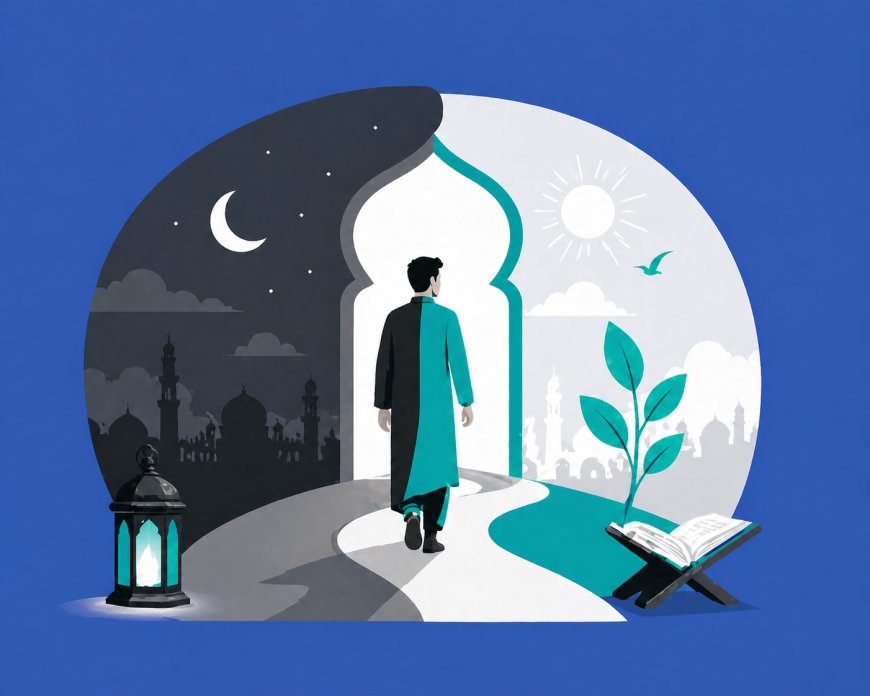
There are rare moments in a person’s life where existence is interrupted—not by crisis, not by loss, but by a shift in rhythm so profound that it forces awareness to return. Ramadan is one of those moments. It does not arrive as an external event, but as an internal disturbance. A disruption of habit, of repetition, of the automatic life most people live without questioning. And in that disruption lies its true power.


What makes Ramadan different is not its rituals alone, but the structure it imposes on consciousness. For eleven months, life flows without resistance. Days blend into each other, behaviors repeat without examination, and time is consumed without being felt. But in Ramadan, something shifts. The day is no longer neutral. It has a beginning that is consciously marked, an end that is awaited, and a rhythm that is experienced physically. Hunger, thirst, waiting—these are not just sensations. They are reminders. Reminders that time is not something to pass through unconsciously, but something to be lived deliberately.
In this state, a person begins to encounter time differently. Not as a resource to be optimized, but as a space to be inhabited. Every hour becomes visible. Every moment carries weight. And for the first time in a long time, the individual is forced to confront a question that routine had buried: how am I living this day?
This question does not arise in comfort. It emerges in absence. In the absence of automatic satisfaction. In the absence of immediate response to desire. When eating is no longer available on demand, when habits are interrupted, when the body itself becomes a site of awareness, the mind begins to see what it could not see before.
Habits.
The patterns that govern behavior without permission. The repeated actions that feel natural but were never chosen consciously. Ramadan does not create these habits—it reveals them. It exposes how much of life is lived on autopilot. How much of what we do is not a decision, but a continuation.
And once seen, a new possibility appears.
If I can stop eating for hours, what else can I stop?
If I can interrupt one pattern, can I interrupt others?
This is where Ramadan moves from ritual to transformation. Because fasting, in its deeper sense, is not about deprivation. It is about control. Not control imposed from the outside, but control discovered from within. The realization that desire, no matter how strong, is not absolute. That behavior, no matter how ingrained, is not fixed.
This realization is quiet, but powerful.
It creates a gap between impulse and action.
And in that gap, something new can be built.
Not just the absence of harmful habits, but the presence of intentional ones. A person begins to re-evaluate what they consume—not only food, but time, attention, and thought. What once felt necessary becomes optional. What once felt distant becomes possible. Priorities reorganize without force. The noise of daily life reduces, and something clearer begins to emerge.
The self, without distortion.
Not the self defined by achievement, or comparison, or external pressure—but the self as it is when stripped of excess. When the constant pursuit pauses, when the mind is no longer reacting but observing, when the individual is left with a simple but profound awareness: this is who I am when nothing distracts me.
And this awareness changes perception.
Relationships are seen differently. What matters becomes clearer. What was urgent becomes secondary. What was ignored becomes central. The person is not given new values—but is reconnected to the ones that were always present but overshadowed.
This is why Ramadan is not an addition to life.
It is a reset.
A recalibration of direction, of attention, of identity.
But this is also where the difficulty begins.
Because the transformation experienced during Ramadan is temporary—unless it is extended beyond it.
Many people feel the shift. They experience clarity, discipline, presence. But once the structure is removed, once the external rhythm disappears, the internal system returns to its previous state. Not because the change was false, but because it was not reinforced.
And this reveals a deeper truth.
Ramadan does not transform you.
It shows you that you can be transformed.
The difference is critical.
One is an event.
The other is a decision.
If Ramadan is treated as a contained experience, its impact ends with the month. But if it is treated as a model—a demonstration of a different way of living—it becomes a starting point. A reference that can be returned to, extended, and built upon.
Because what Ramadan offers is not just a different schedule.
It offers a different relationship with life.
A life where time is felt, not passed.
Where habits are chosen, not inherited.
Where desire is managed, not obeyed.
Where awareness replaces automaticity.
This is not meant to be confined to thirty days.
It is meant to be sustained.
And this leads to the final question, the one that determines whether Ramadan remains a moment or becomes a path:
What will you carry with you when it ends?
Not the rituals alone, but the awareness.
Not the structure, but the discipline.
Not the interruption, but the clarity.
Because the true value of Ramadan is not in what it takes away from you.
It is in what it reveals.
And what it reveals is simple, but not easy:
You are capable of living with more intention than you have allowed yourself.
And once you see that—
you cannot unsee it.
What's Your Reaction?