














































































Intermittent Fasting: A Lifestyle Guide to Weight Loss
A comprehensive guide to intermittent fasting, breaking down popular methods, their biological effects, and how to use them to achieve sustainable weight loss and a healthier lifestyle.
Intermittent fasting did not emerge as just another dietary trend. It appeared as a disruption to a deeply rooted pattern: constant eating without pause. In a world where hunger is avoided and availability is endless, fasting reintroduces something unfamiliar… restraint.


But reducing intermittent fasting to hours without food misses its deeper function. It is not only a metabolic intervention, but a restructuring of behavior, timing, and internal signals.
Beyond food: a shift in control
The modern eating pattern disconnects hunger from timing. Meals are driven by convenience, emotion, and exposure, not biological need.
Intermittent fasting interrupts this loop.
It forces a re-engagement with hunger as a signal rather than a problem. Over time, this shift alone can alter eating behavior more profoundly than calorie restriction.
The biological progression of fasting
Different fasting windows produce different physiological responses. But these effects are not binary. They operate on a continuum.
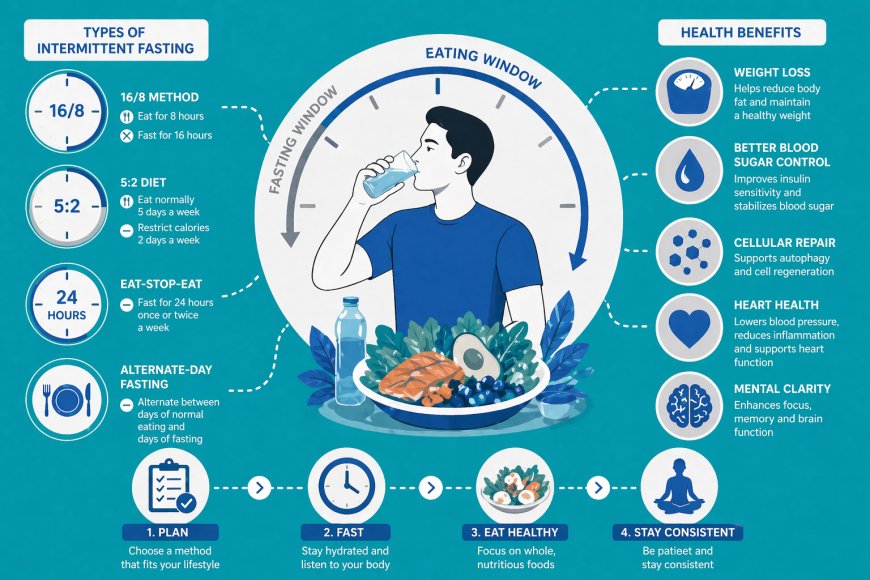
16 hours fasting (16:8)
At this stage, the body transitions from glucose dependence to partial fat utilization. Glycogen stores begin to decline, and insulin levels stabilize.
This phase is often sufficient to improve metabolic markers such as insulin sensitivity and blood sugar regulation. It is accessible, sustainable, and suitable for most individuals starting the process.
However, its impact on significant weight reduction may be limited, particularly in more advanced obesity cases.
20 hours fasting (20:4)
Here, metabolic stress increases. The body relies more heavily on fat oxidation, and cellular repair mechanisms such as autophagy become more active.
Appetite patterns often shift, and some individuals report improved focus and reduced fluctuations in energy.
This stage accelerates results, but it also increases the need for nutritional precision within the eating window.
22 hours fasting (OMAD)
At this level, the body operates in a prolonged fasting state. Fat becomes the dominant energy source, and hormonal adaptations intensify.
While this can lead to rapid weight reduction, it carries higher risks if not managed properly. Nutrient density, protein intake, and overall balance become critical.
It is not a universal solution, and its sustainability varies widely between individuals.
The illusion of linear progress
One of the most misunderstood aspects of fasting is the expectation of continuous results.
The body adapts.
After several weeks, metabolic efficiency increases. Energy expenditure may decrease, and weight loss slows. This is not failure. It is biological adjustment.
Without variation, the same fasting pattern can become less effective over time.
Adaptation and resistance
What is often described as “plateau” is a predictable response.
The body seeks stability. It reduces unnecessary expenditure and optimizes energy use. In some cases, reduced movement and subtle increases in intake during eating windows contribute to this effect.
Breaking this cycle requires variation, not escalation alone. Adjusting fasting duration, modifying physical activity, and improving food quality are more effective than simply extending fasting hours.
Reframing fasting
The most critical mistake is treating intermittent fasting as deprivation.
When approached as restriction, it creates tension and eventual rebound. When approached as structure, it creates clarity.
Fasting does not eliminate hunger. It reorganizes it.
It separates physiological hunger from habitual eating. It introduces timing as a variable, not just quantity.
The real outcome
The value of intermittent fasting is not only in weight reduction.
It lies in restoring a degree of control that was gradually lost in an environment of constant availability.
Not control through force, but through awareness.
Because the core issue in modern eating is not always how much is consumed, but how little attention is given to why, when, and how it is consumed.
And in that sense, intermittent fasting is less about eating less… and more about understanding the act of eating itself.
What's Your Reaction?