Astrophysical Methodologies: Challenging Foundational Assumptions
Astrophysics often relies on long-held assumptions regarding the nature of the universe. Innovative methodologies challenge these foundations, urging a reevaluation of cosmological constants and dark matter theories. Through simulation-based studies and reinterpretation of observational data, astrophysicists investigate alternate explanations for cosmic phenomena. This evolving inquiry reshapes our understanding of space-time and questions established paradigms, fostering an era of creative scientific exploration.

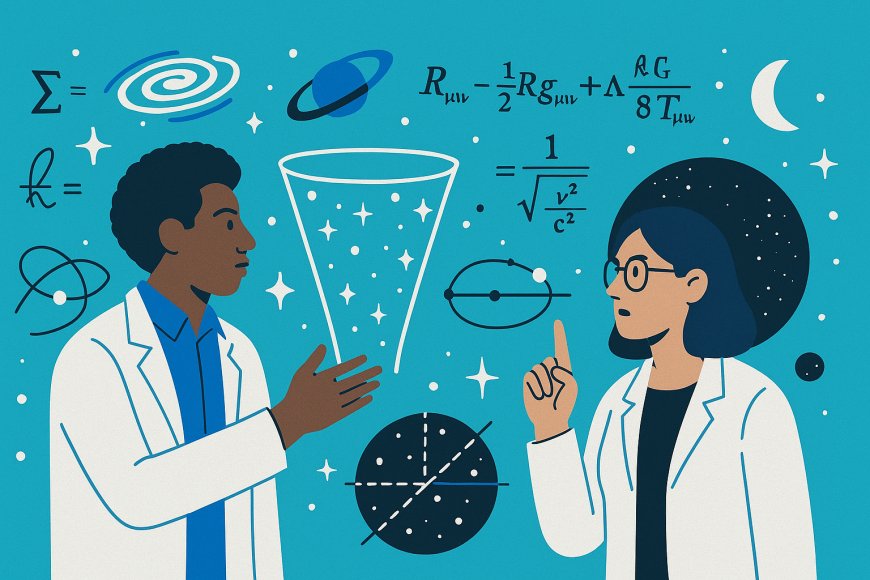
In a typical astrophysical observation, data collected from distant galaxies often fit neatly into existing models that describe the universe's expansion and structure. Yet, recent methodological innovations suggest these models may rest upon assumptions ripe for reevaluation. For decades, the cosmological constant and dark matter have been central to our understanding of cosmic dynamics. However, as precision instruments capture increasingly detailed data, these foundational elements invite scrutiny.


Consider a scenario where astrophysicists deploy a simulation to model galaxy formation without the inclusion of dark matter. Such a study could employ alternative gravity models, like Modified Newtonian Dynamics (MOND), to replicate observed phenomena. Preliminary results from such simulations show deviations from traditional expectations, indicating that alternate principles might better explain certain astrophysical observations. These findings urge a reassessment of dark matter’s role and challenge its status as an indispensable component of the universe. Researchers argue that adjustments to gravitational theories could potentially account for galactic rotation curves without invoking unseen matter.
Revisiting the Cosmological Constant
In another experimental context, consider the work focused on the cosmological constant, established over a century ago to describe the universe's accelerating expansion. Despite its longstanding acceptance, new data from deep-space telescopes suggest variances in this constant's value over time and space. Researchers at cosmology-focused institutions utilize statistical models to analyze these disparities, questioning whether what we perceive as a constant might be more dynamic than previously assumed.
Such studies often involve recalibrating redshift measurements or reevaluating supernova data to detect discrepancies. By constructing detailed simulations that alter the cosmological constant in both time and space, researchers examine the potential for a variable cosmological constant to better fit observed data. The implications are profound, suggesting our universe might not be as uniformly accelerating as classical interpretations propose. This line of inquiry invites a broader philosophical question about the nature of universal constants and their role in shaping cosmic evolution.
The possibility of a dynamic cosmological constant could redefine our understanding of dark energy and its influence on the universe's fate. If these findings hold, they might catalyze a paradigm shift in cosmology, challenging a principle considered bedrock to our understanding of space-time.
Beyond the Observable Universe
The exploration of methodologies extends beyond the visible universe. Theoretical physicists grapple with challenges presented by phenomena like black holes and cosmic inflation. Traditionally, these have been understood within the confines of General Relativity. However, some theorists propose quantum gravity as a more comprehensive framework. In hypothetical studies, researchers apply quantum theory to black hole interiors, seeking to reconcile singularities with quantum mechanics.
These investigations often use complex mathematical models to explore how quantum corrections could eliminate singularities, offering a seamless transition between known physics and the unknown realms inside black holes. This approach not only challenges General Relativity's application at extreme scales but also invites reconsideration of the very fabric of space-time.
In the context of cosmic inflation, experiments test the inflationary model against alternative scenarios. Some propose multiverse models or cyclic universes, which, though speculative, push the boundaries of methodological experimentation. Researchers utilize cosmic microwave background data to test these models, examining their viability in explaining early universe conditions.
These pursuits illustrate a commitment to challenging established cosmological paradigms through precise, innovative methodologies.
Astrophysical methodologies increasingly embrace a revisionist spirit, challenging assumptions once deemed unassailable. This intellectual courage promises a future where scientific inquiry is bounded only by the limits of creativity and insight. As investigators continue to push into uncharted territories, they redefine the questions considered possible, propelling astrophysics into an era of profound exploration.
What's Your Reaction?