














































































What Is an Expo? A Journey Through History, Purpose, and Global Impact
Beyond a simple event, an Expo is a global showcase of a nation's vision for the future. Explore the history and philosophy of World's Fairs, from London 1851 to the upcoming Riyadh Expo 2030.
When people ask a simple question—What is an Expo?—they often expect a simple answer: a global exhibition where countries gather to showcase innovation, culture, and progress. But this answer, while technically correct, is conceptually incomplete. An Expo is not merely an event. It is a civilizational mirror. A stage where nations do not just present what they have achieved, but declare who they are becoming.


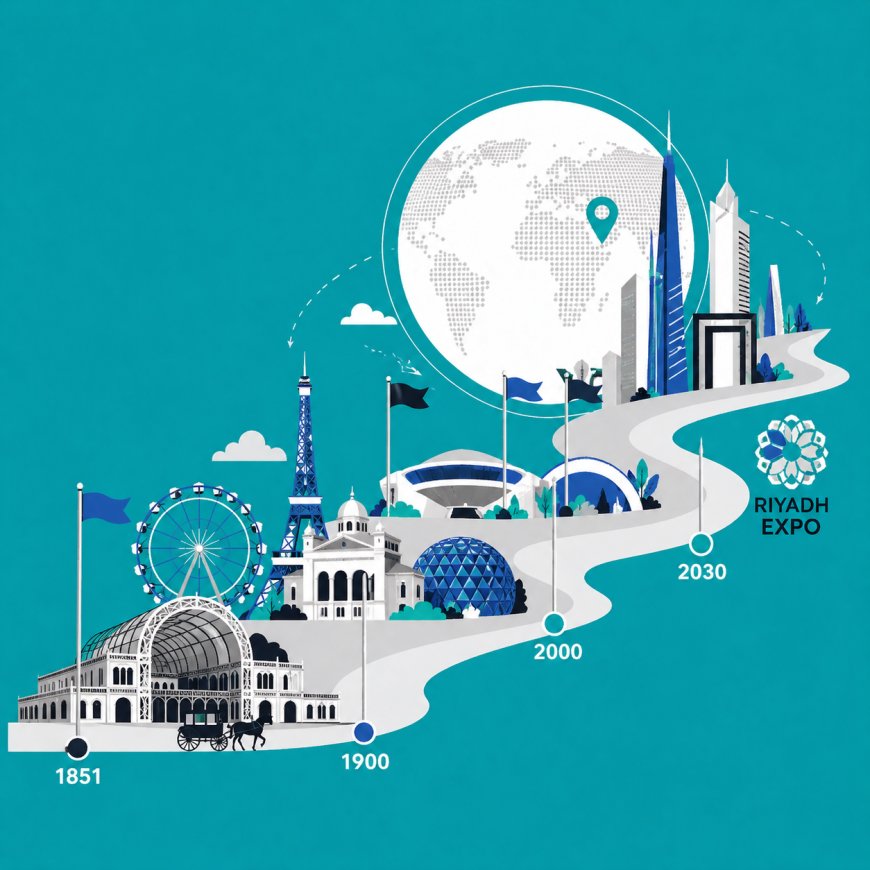
To understand this, one must return to its origins. The first Expo, known as The Great Exhibition, was held in London in 1851. It marked more than the display of industrial achievements—it signaled the birth of a new global consciousness. Nations began to compete not only through power or territory, but through ideas, innovation, and vision. From that moment, the Expo evolved into a recurring global laboratory where the future is tested before it is lived.
Across history, each Expo has functioned as a concentrated expression of its time. The Paris Expo of 1889 gave the world the Eiffel Tower—not just as an architectural feat, but as a symbol of modernity and ambition. Later editions, from Chicago to Shanghai, from Osaka to Dubai, became platforms where humanity negotiated its relationship with technology, nature, and itself.
What distinguishes an Expo from any other international gathering is not scale, but intent. It is not organized merely to display products or attract visitors. It is designed to answer a deeper question: What direction is the world taking, and how does each nation position itself within that trajectory? This is why every Expo is built around a central theme—energy, sustainability, urbanization, food security, or technological ethics. These themes are not arbitrary. They reflect the dominant anxieties and aspirations of the global system at that moment in time.
For example, Expo Milan 2015 focused on food and sustainability, asking how humanity can feed itself without exhausting the planet. Expo Astana 2017 addressed the future of energy, recognizing the urgency of transitioning to sustainable resources. Expo Dubai 2020 emphasized connectivity and collaboration, positioning human cooperation as the engine of progress in an increasingly fragmented world.
In this sense, an Expo is less about what is displayed and more about what is declared. It is where nations construct narratives about their future. Japan’s upcoming Expo Osaka 2025, for instance, centers on designing a better life through the integration of technology and humanity. China’s Expo Shanghai 2010 explored how cities could evolve into spaces that nurture both innovation and human well-being. Each Expo becomes a strategic statement—a synthesis of identity, ambition, and capability.
But the significance of Expo goes even deeper. It operates at the intersection of culture, politics, and imagination. It allows nations to renegotiate how they are perceived globally, not through rhetoric, but through experience. Architecture, design, storytelling, and technology converge to create environments where visitors do not just observe—they feel the vision being proposed. In this way, Expo becomes a tool of soft power, shaping global perception through immersion rather than persuasion.
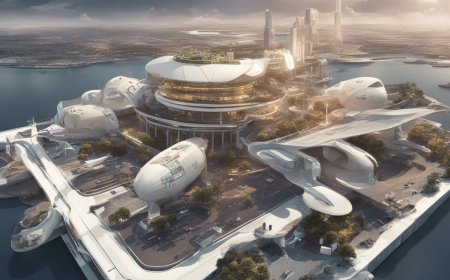
This is why the upcoming Expo 2030 in Riyadh carries particular weight. It is not simply another addition to the Expo timeline. It represents a shift in the geopolitical and cultural landscape. Saudi Arabia’s hosting of this event signals its intention to reposition itself—not only economically, but intellectually and creatively—within the global system.
The theme of the Saudi Expo, centered around inspiring realities for a promising future, reflects a broader transformation. It aligns with the Kingdom’s strategic direction toward sustainability, smart cities, and knowledge-driven development. But beyond policy, it represents a narrative shift: from being a participant in global change to becoming a contributor to its design.
Scheduled between October 2030 and April 2031, the Riyadh Expo will function as a platform where ideas are not only presented but contested, refined, and expanded. It will bring together diverse perspectives at a time when the world faces complex transitions—climate challenges, technological disruption, and evolving social structures. In this environment, Expo becomes more than an event. It becomes a forum for collective thinking.
Ultimately, the question What is an Expo? cannot be answered in a single definition. It is, simultaneously, an exhibition, a competition, a dialogue, and a vision. It is a place where nations rehearse the future before it arrives. Where architecture becomes philosophy, technology becomes narrative, and culture becomes strategy.
And perhaps most importantly, it is a reminder that the future is not discovered—it is constructed.
What's Your Reaction?