





















































































Individual Differences: The Key to Understanding Human Behavior in Scientific Research
Explore how **individual differences** like gender, nationality, and educational level are crucial to scientific inquiry. Learn why ignoring these variables can lead to flawed research and ineffective public policy.
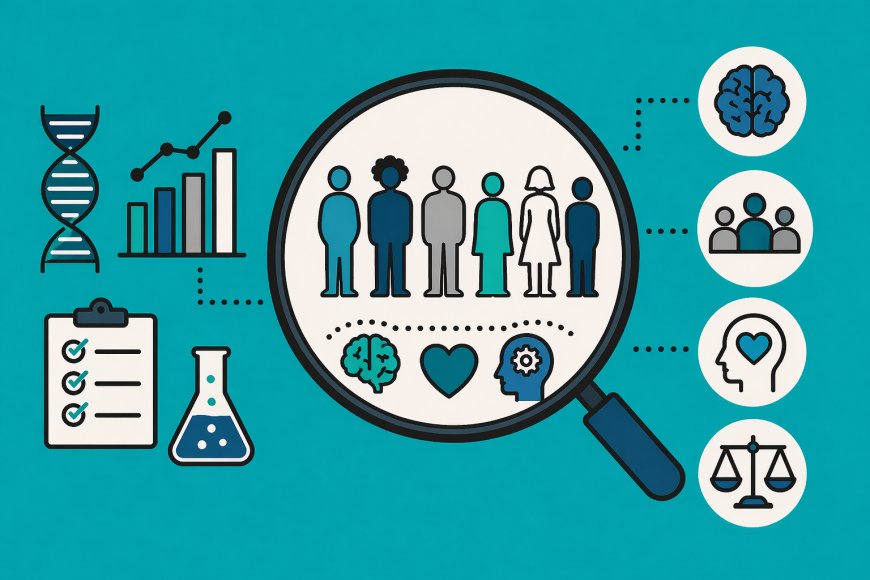
In the midst of rapid social, cultural, and economic transformations across Arab and Saudi societies, individual differences emerge as a fundamental lens for understanding human behavior and shaping precise, equitable research and policy. The individual cannot be reduced to observable traits alone, but must be understood through the dynamic interaction between personal attributes and contextual factors such as age, gender, nationality, income, education, and professional status.


Ignoring these differences produces flawed science and superficial policy, ultimately reinforcing inequality rather than resolving it. The central argument is clear: failure to recognize human variation leads to policies that serve no one effectively.
Individual Differences as an Analytical System
Individual differences are not merely demographic descriptors but core analytical variables that shape study design, data collection, interpretation of findings, and the generalization of results. They reflect lived experiences, psychological, cultural, and social, that influence behavior and responses to interventions.
Modern research requires moving beyond isolated variables toward an intersectional framework. Age reflects psychosocial development, gender reflects both biological and social dimensions, and nationality reflects legal, political, and cultural realities. These variables must be analyzed as interconnected systems rather than as separate and independent factors.
The Saudi and Arab Context
Western frameworks, shaped by individualistic and relatively secular societies, cannot be transferred directly into Arab contexts. Arab societies, including Saudi Arabia, are more communal in structure and more deeply shaped by religion, culture, tribe, and family.
Social class, for example, is not determined solely by income or education. It may also intersect with tribal affiliation, regional identity, and family background. Gender roles are similarly shaped by religious and cultural expectations, while nationality carries legal and institutional consequences affecting employment, healthcare, and social inclusion. When these contextual realities are ignored, research loses both credibility and relevance.
The Problem of False Generalization
One of the most serious methodological consequences of neglecting individual differences is false generalization. Findings may appear broad and representative, while in reality they reflect only a narrow segment of the population. This results not only in weak science, but also in epistemological injustice, because entire groups are excluded from representation.
This distortion becomes especially harmful when policy is built upon such incomplete evidence. Health research that overlooks gender may fail to capture women’s needs. Educational policy that ignores class and income may appear neutral while quietly reproducing inequality. In this sense, overlooking difference is not a technical oversight but an ethical failure.
Gender as a Complex Analytical Variable
Gender is among the most frequently used variables in research, yet it is often employed without sufficient conceptual precision. A crucial distinction must be made between sex as a biological classification and gender as a social and cultural construct. Confusing the two weakens analysis and narrows interpretation.
Scientific research has long suffered from structural male bias, where male experience was treated as the norm and female experience as secondary or exceptional. This bias has shaped medical, psychological, and social research alike. In conservative societies, including those in the Gulf, the problem may deepen when women are underrepresented in study samples or when male-centered findings are generalized across society.
Gender must therefore be treated not as a simple descriptive label, but as an interactive variable that intersects with age, education, income, geography, and marital status. The experience of a highly educated working woman in Riyadh is not comparable to that of a woman in a rural setting with limited educational opportunities, even though both are classified within the same gender category.
In Saudi Arabia, recent transformations in women’s education, employment, and public participation have made gender analysis even more important. These shifts cannot be understood without considering the cultural structure that preceded them and the tensions women may face between aspiration and expectation. Serious research in this context requires gender analysis that is culturally grounded, psychologically aware, and methodologically rigorous.
Race and Nationality as Structural Determinants
Race and nationality are among the most sensitive variables in scientific inquiry because they are tied to long histories of inequality, privilege, exclusion, and access. Race is not simply about biology or genetics. It reflects social positioning and cultural identity. Nationality, meanwhile, shapes legal status, rights, access to services, and professional opportunity.
Saudi society is far more diverse than is often assumed. It includes multiple regional identities among citizens, alongside large resident populations from Asia, the Middle East, Africa, and other parts of the world. This diversity is socially rich, but it also produces important disparities in opportunity, representation, and daily experience.
Research that overlooks nationality or ethnic identity risks producing misleading averages that hide real inequalities. A study on job satisfaction, for instance, may present broadly positive findings while masking substantial differences between citizens and expatriate workers. Without such distinctions, the result is a flattened picture of reality.
Integrating race and nationality into research is not merely a methodological refinement. It is essential for better public health interventions, better educational design, and more honest workforce analysis. A science that seeks truth must illuminate these differences rather than conceal them.
Educational Level as a Structural Variable
Educational level is often treated superficially as a simple demographic category, yet its influence runs far deeper. Education is not only the number of years studied or the degree obtained. It is a social, cultural, and economic system that shapes awareness, expression, confidence, and the ability to engage with institutions and ideas.
In research, education is one of the strongest factors explaining differences in attitudes, values, health behavior, social participation, and responses to policy. In Saudi Arabia, education has transformed dramatically over recent decades, contributing to the rise of an educated middle class and reshaping opportunities across generations and regions. Yet this transformation has not been uniform. Differences remain across gender, geography, specialization, and the quality of educational institutions.
Reducing education to degree level alone obscures important distinctions. Two individuals with similar formal qualifications may differ profoundly in intellectual preparation, language skills, and analytical ability depending on where and how they were educated. Ignoring such differences weakens interpretation and produces crude generalizations that do not reflect lived reality.
Toward a More Context-Sensitive Research Paradigm
What is needed is not the simple translation of Western concepts into Arabic settings, but the reconstruction of the conceptual and methodological framework itself from within the reality of Arab societies. Research tools must be domesticated in a deeper sense. They must be built to reflect the actual interplay between gender, age, education, class, culture, and legal status.
This requires a research culture that takes difference seriously at every stage, from design and sampling to interpretation and recommendation. It also requires research institutions and universities to value complexity rather than flatten it for convenience. Only then can scientific knowledge become more just, more precise, and more useful for public policy.
Conclusion
Individual differences are not a secondary detail in scientific inquiry. They are one of its central foundations. To ignore them is to misrepresent reality, exclude voices, and produce knowledge that is both incomplete and potentially unjust.
To integrate them properly is to move toward a science that is more accurate, more context-aware, and more faithful to the societies it seeks to understand. In the Arab and Saudi context especially, this is not merely a methodological preference. It is an ethical and epistemological necessity.
What's Your Reaction?