



















































































The Cognitive Dynamics of Augmented Reality: Bridging Perception and Computation
Augmented Reality (AR) is transforming how humans perceive and interact with the world, blending digital information with physical environments. This integration raises profound questions about perception, cognition, and the boundaries of reality. By examining specific studies and experiments, we can explore AR's cognitive implications, from perception shifts to changes in computational models of the mind. AR challenges traditional cognitive frameworks by introducing new paradigms of information processing and perception. This article examines these shifts and their potential impact on scientific and technological landscapes.

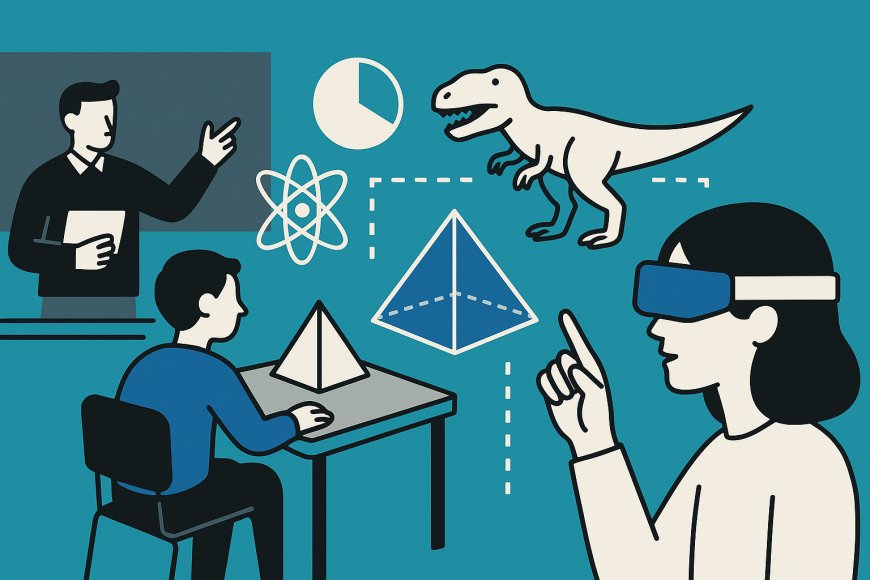
The synthesis of digital and physical information in Augmented Reality (AR) has begun to redefine human perception and interaction. Consider a scenario where AR is employed in an educational setting, overlaying dynamic, real-time simulations onto physical models in a classroom. This integration of virtual elements with tactile experiences is reshaping the cognitive landscape by altering sensory input and blending multiple streams of information into a single experiential plane. The implications for cognitive science are profound, demanding a reexamination of how perception, attention, and memory function in these augmented scenarios.


In a typical observational study, participants navigating an AR-mediated environment demonstrate heightened levels of spatial awareness and memory retention compared to traditional learning environments. The cognitive workload required to integrate and process information across both digital and physical domains appears to engage unique neural pathways, suggesting a parallel processing model that challenges conventional monolithic interpretations of sensory data processing. This parallel processing not only broadens the scope of attention but also redefines the limitations of human perceptual capabilities, enabling individuals to engage with complex informational arrays more efficiently. Such cognitive adaptations are indicative of a broader potential for neuroplasticity driven by technologically enriched environments.
Beyond individual cognitive processing, AR environments foster novel modes of interaction between users and technology. In behavioral experiments involving AR-based collaborative tasks, groups exhibit enhanced problem-solving abilities and increased creative output. These results suggest that the shared cognitive framework provided by AR can unify diverse sensory inputs into a cohesive group experience, thereby augmenting collective intelligence. The implications for educational and professional settings are significant, suggesting that AR could be a catalyst for more effective teamwork and innovation.
Augmented Reality and Cognitive Frameworks
The introduction of AR into daily life challenges established cognitive models by reshaping fundamental concepts of reality and perception. Traditional cognitive frameworks often rely on the brain's ability to segregate and interpret sensory inputs in a linear fashion. However, AR environments require users to synthesize information from multiple overlapping sensory streams, creating a complex tapestry of perceptual data that must be rapidly decoded and understood. This multi-layered approach to perception necessitates a revised understanding of cognitive processes, particularly with regard to attentional capacity and sensory integration.
Experimental setups utilizing AR in complex problem-solving scenarios reveal that participants are capable of maintaining simultaneous attention to both virtual and real-world stimuli. Such tasks highlight the brain's adaptive capacity to prioritize and filter relevant information, a process that is pivotal to functioning within dynamic, stimulus-rich environments. These findings raise important questions about the limits of human attention and whether AR could inadvertently lead to cognitive overload or if it enhances selective attention mechanisms, enabling more effective information filtering.
Moreover, AR's impact extends to the procedural memory domain, where repeated interactions with augmented systems can lead to the internalization of new cognitive pathways. In longitudinal studies, individuals who regularly engage with AR technologies exhibit enhanced procedural memory and skill acquisition rates. This suggests that the cognitive frameworks underpinning skill development are highly adaptable to the inclusion of augmented information, potentially accelerating learning in both digital and physical realms.
Perception, Reality, and Computational Models
AR's transformative effect on human cognition also necessitates a reevaluation of computational models of the mind. Existing models often rely on static assumptions about perception and information processing. However, AR's dynamic and interactive nature introduces variability and context-dependence that traditional models fail to account for. In computational simulations, the integration of AR parameters reveals emergent properties of cognitive processing that align more closely with real-world complexities. This evolution of computational models is crucial for developing predictive tools that can better replicate human cognitive processes in AR environments.
Consider a computational experiment that simulates AR-driven learning environments. The model incorporates real-time feedback loops and adaptive learning pathways, allowing researchers to observe how virtual stimuli influence cognitive development over time. Such models demonstrate that perception and cognition are not static, but rather dynamic processes that evolve with continuous interaction with technology. The iterative nature of learning in these models highlights the importance of feedback and adaptability in cognitive processes, suggesting that AR could serve as a powerful tool for refining machine learning algorithms through its unique insights into human cognition.
Finally, the confluence of AR technology with cognitive modeling offers fertile ground for developing new interfaces and applications that optimize human-technology interaction. By harnessing the insights gleaned from both empirical studies and computational analyses, future AR systems can be designed to complement and enhance human cognitive capabilities, pushing the boundaries of what is considered achievable in human-computer interaction.
Looking to the future, the fusion of AR and cognitive science could redefine not only how we interact with technology but also how we understand the very nature of human perception and thought. As AR becomes more integrated into daily life, its potential to cultivate new forms of cognition and expand the boundaries of human capability is boundless. This evolution paints a compelling picture of a future where the melding of digital and physical worlds leads to unprecedented cognitive advancements.
What's Your Reaction?