



































































The Tyranny of the 'Ideal Body': Why Our Obsession with Thinness is Toxic
This article critiques the modern obsession with an ideal weight, its psychological toll, and how societal pressures have turned the body into a product to be modified and sold.
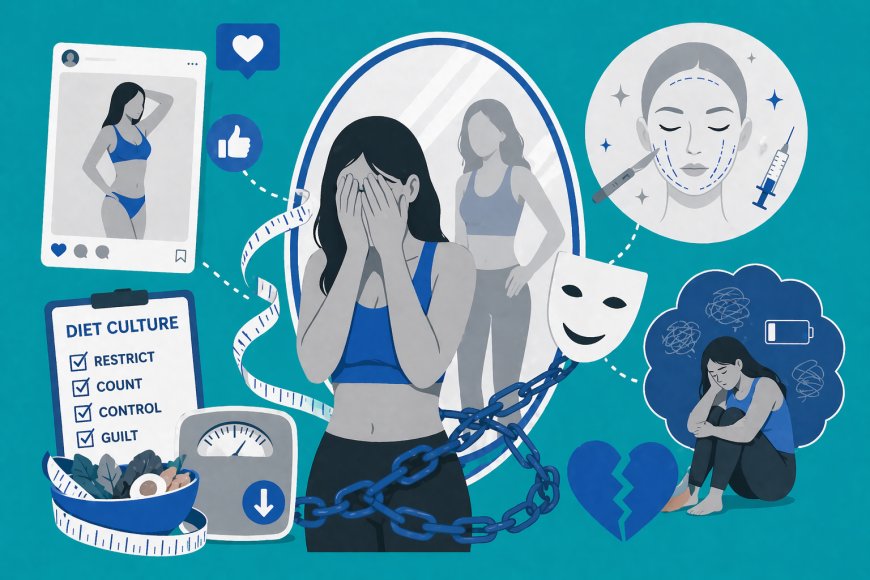
There is a quiet contradiction at the heart of modern health culture: we speak about balance, yet we live in a state of constant restriction. The question is no longer how to lose weight, but what we lose in the process of trying.


At some point, the body stopped being a living system to care for, and became a project to control. Meals are no longer moments of nourishment, but calculations. Fullness is no longer a natural signal, but a mistake to correct. And slowly, without noticing, the relationship with food shifts from trust to suspicion.
The hidden cost of the “ideal”
The idea of an ideal weight appears simple, almost scientific. But beneath that simplicity lies a psychological cost that is rarely discussed.
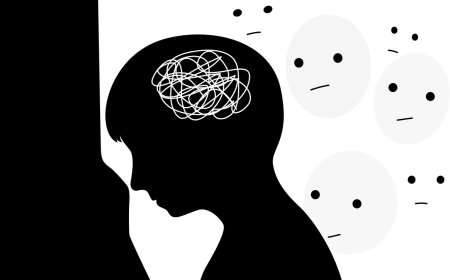
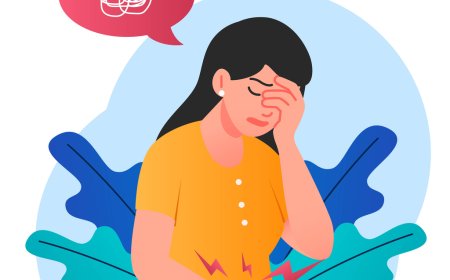
Maintaining that number often demands a continuous state of vigilance. It asks the individual to negotiate daily between desire and denial, between hunger and discipline. Over time, this tension does not disappear; it accumulates.
The real issue is not the number on the scale, but the price paid to maintain it. When the body becomes an adversary, and food becomes a source of anxiety, the equation is already broken.
Between discipline and quiet exhaustion
There is a difference between caring for the body and policing it.
Care is sustainable. It allows flexibility, variation, and recovery.
Control, when pushed too far, becomes a form of internal pressure that reshapes behavior around avoidance rather than balance.
Many people do not fail diets because they lack willpower. They disengage because the model itself demands a level of rigidity that contradicts human biology and psychology.
The silence within the system
In clinical spaces, weight loss is often presented as a linear process. Plans are structured, targets are set, and results are expected.
What is less frequently emphasized is the body’s resistance. Biological systems adapt. Metabolism adjusts. Appetite signals intensify. And for many, weight regain is not an exception but a common outcome.
This creates a silent gap between expectation and reality. The individual carries the perceived failure, while the system rarely questions its assumptions.
When the body becomes a product
Beyond health, another force shapes the perception of the body: the economy of appearance.
Standards of beauty are no longer neutral. They are produced, amplified, and constantly updated. The body is compared, adjusted, and evaluated against external models that shift faster than any individual can follow.
In this context, modification is not always driven by need, but by comparison. The body becomes something to optimize, not something to inhabit.
The deeper question
The pursuit of health can begin as an act of self respect. But when it turns into continuous dissatisfaction, it loses its original meaning.
The problem is not in wanting to improve, but in the framework that defines what improvement means. If the standard is always external, always moving, and always demanding more, then no result will ever feel sufficient.
Toward a different relationship
What is needed is not the rejection of health awareness, but its recalibration.
Food does not need to be feared. The body does not need to be corrected at every moment. And weight does not need to carry the full burden of identity, value, or acceptance.
A more stable approach begins by shifting the focus from control to understanding, from restriction to regulation, and from external validation to internal alignment.
Because the real question is not how the body looks when it meets expectations, but how it feels when it is no longer in conflict with itself.
What's Your Reaction?