
















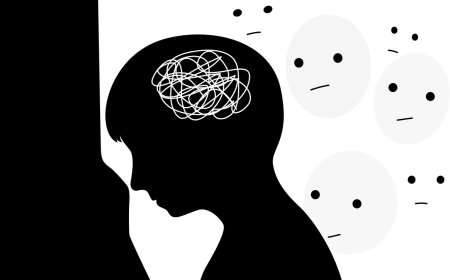






































































The Lens of Insufficiency: Why We Condemn Our Relationships to a Missing 10%
This article delves into the psychological phenomenon of focusing on the missing 10% in relationships, overlooking the abundant 90% that is present. It explores how cognitive biases and a fear of contentment can lead to dissatisfaction and the breakdown of relationships.

There is a quiet realization that arrives late—often after a relationship has ended, after the conversations fade and the daily rhythm dissolves into memory. It is not the loss itself that surprises us, but the recognition of what we once had and failed to see.


We discover, too late, that completeness was not absent. We were.
We were absent from seeing it.
This is not a failure of love. It is a failure of perception.
When the Mind Learns to See What Is Missing
In every relationship, there is an invisible force shaping how we feel, judge, and respond. It is not the actions of the other person, nor the circumstances we live in. It is the way our mind chooses to weigh what is present and what is not.
The mind does not experience reality neutrally. It filters. It selects. It amplifies certain details and silences others. And over time, this selective attention becomes a pattern.
A small absence appears—something that is not aligned with our expectations. At first, it is just a detail. But then it is repeated in thought. Revisited in memory. Reinforced through internal dialogue.
Slowly, it grows.
Not in reality, but in perception.
The missing 10% begins to dominate awareness, while the present 90% fades into the background.
This is what can be called the lens of insufficiency.
It does not distort everything. It distorts enough.
The Addiction to Imperfection
What is rarely discussed is that some minds do not simply notice lack—they become accustomed to it.
Not because the lack is significant, but because dissatisfaction becomes familiar. A habit forms: searching for what is wrong, identifying what is incomplete, questioning what could have been better.
Even in relationships where there is warmth, understanding, and shared presence, the mind begins to introduce a quiet disruption:
“But something is missing.”
This “something” is rarely defined clearly. It shifts. It adapts. It evolves. But it remains present, anchoring attention to absence rather than presence.
And over time, this focus becomes identity.
The relationship is no longer experienced as it is.
It is experienced through what it is not.
When Imagination Replaces Reality
After separation, the mind often intensifies its distortion.
It constructs alternatives.
It imagines scenarios in which the missing 10% would have been fulfilled. It creates hypothetical partners, ideal conditions, perfect alignments. And in comparison, what was real begins to seem insufficient.
But this comparison is flawed.
Because the imagined scenario has no weight.
It does not include daily friction, emotional complexity, or the unpredictability of real human connection. It exists without resistance, without contradiction, without reality.
And when reality returns—when new experiences are tested—it often reveals something unexpected:
What was missing was not enough to sustain a relationship.
And what was present was far more valuable than it seemed.
The Psychology Behind the Distortion
This pattern is not random. It is supported by well-established cognitive mechanisms.
One of them is confirmation bias—the tendency of the mind to search for evidence that confirms what it already believes. Once the idea of insufficiency is formed, the mind begins to collect proof. Moments that align with this belief are remembered. Moments that contradict it are minimized.
Another is negativity bias—the tendency to give more weight to negative experiences than positive ones. A single moment of disappointment can outweigh multiple moments of connection, not because it is larger, but because it is more psychologically salient.
Together, these biases create a closed loop.
The mind sees lack, confirms lack, and strengthens its belief in lack.
The Fear of Contentment
There is also a deeper layer—one that is less visible.
Some individuals struggle not with lack, but with sufficiency.
Contentment feels unfamiliar. Stability feels like stagnation. Peace feels like something is missing.
In such a state, the mind continues to search—not for improvement, but for disruption. It introduces dissatisfaction to maintain movement, even when movement is no longer necessary.
And in doing so, it dismantles what was already enough.
Relationships as an Exercise in Vision
Relationships do not always fail because something essential was missing.
They fail because perception became narrow.
Because attention became selective.
Because the mind learned to see absence more clearly than presence.
A healthy relationship is not built on perfection. It is built on the ability to see value despite imperfection. To recognize what is present, even when it is incomplete. To appreciate consistency, even when it is not dramatic.
Love is not the elimination of gaps.
It is the refusal to let those gaps define everything else.
Reclaiming the Ability to See
The real work, then, is not in finding a perfect partner.
It is in correcting the lens.
To ask, with honesty: what am I training my mind to focus on?
Am I reinforcing dissatisfaction?
Am I overlooking what is working?
Am I comparing reality to imagination?
Because the answer to these questions determines not only the fate of relationships, but the quality of experience itself.
The Cost of Misperception
The tragedy is not losing someone who was not right.
It is losing someone who was enough, because we trained ourselves not to see it.
It is realizing, after absence, that what once felt ordinary was in fact stability.
That what felt incomplete was in fact sufficient.
That what we dismissed quietly was the very thing that could have lasted.
And this realization, once it arrives, cannot restore what has been lost.
It can only redefine what comes next.
In the End
Relationships do not collapse solely because of the size of their imperfections.
They collapse because of the way those imperfections are perceived, repeated, and magnified.
And the one who cannot see contentment will not recognize completeness—
even when it is already in their hands.
What's Your Reaction?