











































































The Paradox of Free Education: When a Gift Becomes a Burden
This article explores the paradox of free university education, arguing that while it provides access, it can also create a mindset of entitlement and intellectual dependence. It examines the gap between education as a service and education as a valuable, lifelong pursuit.
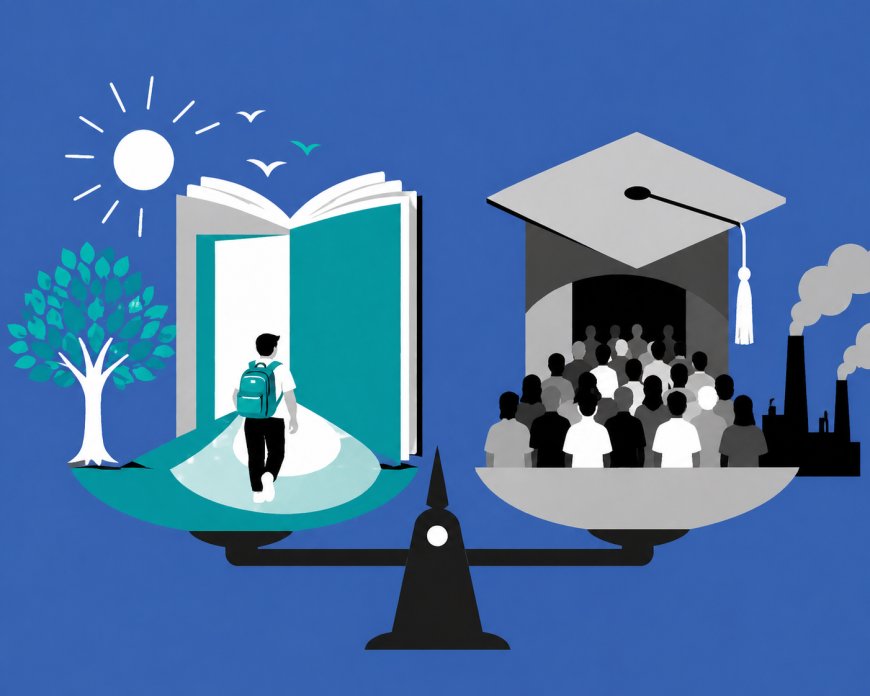
In theory, free education represents one of the most noble ambitions of modern societies. It promises equality, accessibility, and the removal of financial barriers that prevent individuals from reaching their intellectual potential. It is framed as a gateway to collective progress, where knowledge is no longer a privilege but a shared right. Yet, when examined beyond its ideal form, a more complex and uncomfortable reality begins to emerge. The issue is not in the principle of accessibility itself, but in how accessibility reshapes the relationship between the individual and knowledge. Because when something becomes permanently available without cost, it risks losing not its importance, but its perceived value.


This is where the contradiction begins. Education, at its core, is not a service to be consumed. It is a transformation that must be earned. It requires effort, sacrifice, and a continuous engagement that extends beyond formal structures. But when education is delivered in a way that resembles a free service—something guaranteed, expected, and detached from personal investment—it subtly shifts from being a journey of intellectual formation into a transactional process aimed at obtaining a certificate. The university becomes a passage, not a destination. And the student becomes a recipient, not a seeker.
The psychological mechanism behind this shift is neither surprising nor new. Human behavior consistently demonstrates that value is often linked to cost—not only financial, but emotional and cognitive. What demands effort is internalized more deeply. What requires sacrifice is protected more carefully. When education carries no visible cost, many individuals unconsciously assign it a lower priority. Not because they reject knowledge, but because they have not been conditioned to pursue it actively. The result is not a lack of intelligence, but a lack of urgency. Learning becomes something to complete, not something to embody.
Over time, this creates a structural gap between education as a right and education as a value. A right can be provided. A value must be constructed. And when societies rely heavily on providing the former without cultivating the latter, they risk producing generations that are academically qualified but intellectually passive. Individuals who can navigate exams, but struggle to navigate uncertainty. Who can reproduce information, but hesitate to produce insight. This is not a failure of systems alone, but of the relationship those systems create between effort and reward.
The consequences extend beyond the classroom. One of the most revealing indicators of this dynamic appears after graduation. In environments where education has been entirely free, there is often resistance to investing in further learning. Paid courses are avoided. Books are seen as optional. Specialized knowledge becomes something desirable only if it is available without cost. This is not merely economic behavior—it is cultural conditioning. A mindset where knowledge is expected to be given, not pursued. And in a world where continuous learning is essential, this mindset becomes a limitation that is not immediately visible, but deeply restrictive over time.
This helps explain a broader pattern observed globally. Many of the institutions that lead in research, innovation, and intellectual output operate within systems where education involves a form of personal investment—financial or otherwise. This investment does not guarantee quality, but it alters perception. The student is not only attending; they are committing. Each hour carries weight. Each decision has cost. And this cost creates a different form of engagement—one that aligns effort with intention.
However, this does not mean that the solution lies in removing free education altogether. Such a conclusion would ignore the importance of access and equity. The real issue is not whether education is free, but whether it is experienced as valuable. And value cannot be imposed externally. It must be cultivated internally. This requires a redesign—not of availability, but of expectation.
Education must shift from being something delivered to something demanded from the individual. Systems must move beyond transferring information toward building intellectual independence. Students must be placed in environments where curiosity is required, not optional. Where research is not an assignment, but a habit. Where success is not measured by attendance, but by contribution. Where the individual understands that the institution provides access—but meaning is self-constructed.
This also requires introducing forms of cost that are not purely financial. Commitment, accountability, competition, and responsibility can function as equally powerful mechanisms for creating value. When students are required to invest time, effort, and ownership, the experience transforms. It ceases to be passive and becomes participatory.
There is also a deeper philosophical layer to this discussion. When a system provides everything without requiring internal effort, it risks producing dependency rather than autonomy. The individual becomes accustomed to receiving rather than seeking. To following structure rather than creating it. And this extends beyond education into thinking itself. Because the ability to learn independently is closely tied to the ability to think independently.
A society that consumes knowledge without producing it remains dependent, regardless of how educated it appears on paper.
This is why the question is not whether free education is good or bad. It is whether it creates individuals who take ownership of their intellectual development. Whether it produces seekers, not just recipients. Whether it transforms knowledge from a service into a personal project.
Because in the end, progress is not created by access alone.
It is created by those who go beyond what is given.
Those who do not wait for knowledge to reach them, but move toward it with intention.
Those who understand that the true cost of education is not what you pay for it—
but what you are willing to give to it.
What's Your Reaction?