








































































Microwave Dangers: From Reheating Food to Toxic Chemicals
Uncover the hidden dangers of microwave use, from uneven heating and nutrient loss to the formation of toxic compounds like acrylamide. This guide covers food and container safety to help you use your microwave wisely.
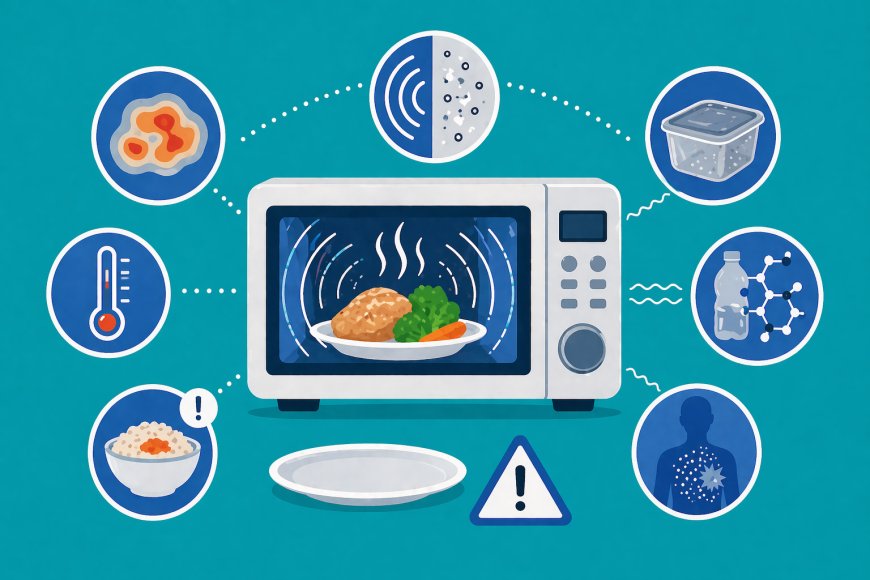
In the midst of the widespread use of microwave ovens in homes and offices, it is often overlooked that this device is not equivalent, in its thermal structure or chemical impact, to any traditional cooking tool. The electromagnetic waves that heat food do not adhere to a standard of thermal uniformity and can produce chemical reactions and compounds that may vary between beneficial and harmful depending on the food's structure, its material, and its container. This scientific series does not aim to condemn the microwave or to sensationalize its effects, but rather to deconstruct its physical mechanisms, analyze its chemical changes, and explore its health dimensions in light of modern studies. It seeks to arrive at well-supported recommendations that avoid harmful use and guide toward proper dietary behavior.


A Brief History: Who Invented the Microwave? And What Were Its First Uses?
The invention of the microwave oven is credited to the American engineer Percy Spencer in 1945, while he was working on radar systems for the Raytheon company. Spencer noticed by chance that a chocolate bar in his pocket had begun to melt while he was standing in front of an active magnetron, a device that produces high-frequency electromagnetic waves. This curious discovery prompted him to conduct a series of experiments. He directed the waves at corn kernels and observed that they exploded and turned into popcorn. He then tested heating an egg, which also exploded. These phenomena led the company to develop the first industrial model known as the Radarange, a commercial microwave oven the size of a refrigerator and nearly two meters tall. It was used only in military canteens and large restaurants due to its bulk and high cost. The microwave was not introduced to the consumer home market until the late 1960s and early 1970s, with a reduction in size and cost. It subsequently became one of the most widespread appliances in the world, thanks to its speed and ease of use.
The Principle of Microwave Operation and Its Physical Impact
Microwave ovens are among the most commonly used heating appliances in domestic and office environments. Their operating principle is based on generating electromagnetic waves at a frequency typically around 2.45 gigahertz. These waves stimulate water and fat molecules within the food to vibrate at high speeds, which generates internal heat, causing the food to be heated from the inside out.
The Nature of Microwave Heating: A Wave-Molecular Interaction
Electromagnetic waves penetrate the outer surface of food to a depth ranging from 2 to 4 centimeters, depending on the food's density and composition. Within this depth, water molecules, which are polar by nature, begin to vibrate in response to the rapid change in electric fields. This frictional motion generates internal heat that warms the food relatively quickly compared to traditional heating methods that rely on heat transfer from the outside in via conduction or convection. However, this model of heating has a fundamental flaw: uneven heat distribution, a topic to be addressed in a separate section. It is important to note that differences in the water and fat content in various parts of the food lead to variations in wave absorption. This explains why some parts may be very hot while others remain cold, despite being heated for the same duration and at the same power.
Deposited Energy and Its Effect on Molecular Structure
At the molecular level, exposing food to microwave radiation does not make it radioactive, a common misconception. The waves used are non-ionizing, and their energy is not sufficient to detach electrons from atoms, as is the case with X-rays or gamma rays. Nevertheless, they cause rapid internal thermal changes, which differ in nature from slow, traditional heating. This difference can lead to:
- Rapid collapse of the tertiary structure of proteins.
- Selective breakdown of some hydrogen and weak bonds.
- Formation of internal steam pockets that can lead to localized explosions or harmful expansion.
Physical Considerations Related to Food Components
Foods with high fat content absorb waves more slowly than those rich in water but retain heat for a longer period. Frozen foods or those with non-uniform layers are among the most difficult to heat evenly and may retain coldness or bacteria in their inner layers despite apparent external heating.
The Difference Between Reheating and Preparing Food Using a Microwave
Many people confuse the concepts of reheating and cooking/preparation in a microwave, thinking the appliance is capable of performing both tasks with the same efficiency. However, the technical and chemical reality reveals fundamental differences in the mechanisms, goals, and nutritional and health outcomes of both uses.
Reheating
Reheating means raising the temperature of previously cooked food to a level suitable for consumption. This use is characterized by the following:
Characteristics:
- Short duration (usually less than 3 minutes).
- Does not require internal cooking of protein or a change in chemical structure.
- The goal is to reach a temperature of 74 C to ensure safety from bacteria.
- Often used for ready-made meals, pre-cooked dishes, beverages, or canned goods.
Advantages:
- Time-efficient.
- Does not significantly affect the nutritional composition.
- Does not require constant monitoring.
Potential Risks:
- Uneven temperature within the food, which may leave some bacteria alive.
- The risk of cold spots, especially in dense or multi-layered foods.
Preparation/Cooking
This refers to cooking raw or not fully cooked food, such as meat, chicken, eggs, hard vegetables, grains, and more.
Characteristics:
- Longer duration (from 5 to 15 minutes).
- Requires uniform heating of both the inside and outside of the food.
- The goal is complete cooking through physical and chemical reactions like protein denaturation, gelatinization, and the Maillard reaction.
Challenges:
- Lack of thermal uniformity due to the nature of the waves, which only penetrate a few centimeters.
- A high risk with poultry and eggs if sufficient internal temperatures are not reached.
- Some foods like raw rice or potatoes may not cook properly and remain unsafe.
Exceptions:
- Delicate vegetables like broccoli or green beans can be prepared with high efficiency in the microwave using a small amount of water with good covering.
- Some ready-made industrial foods are specifically designed to be fully cooked in the microwave.
Direct Comparison
| Element | Reheating | Preparation/Cooking |
|---|---|---|
| Goal | Raising the temperature of ready food | Cooking raw food |
| Time | Short (a few minutes) | Longer (5 to 15 minutes) |
| Risk Level | Medium linked to cold spots | High linked to incomplete cooking |
| Common Foods | Leftovers, drinks, canned goods | Meats, eggs, grains, potatoes |
| Safety | Depends on stirring and turning | Requires accurate internal temperature measurement |
Scientific Recommendation: Reheat, Don't Cook
Based on scientific and experimental literature, health and food safety authorities, including the FDA, USDA, and EFSA, recommend not using the microwave as a primary means of preparing raw or uncooked food, especially foods that require deep or uniform cooking, such as:
- Chicken and beef
- Raw eggs
- Rice, potatoes, and lentils
- Frozen foods with a multi-layered structure
This guidance is based on three central reasons:
Non-Uniform Thermal Structure
The microwave heats with waves that penetrate only a few centimeters, leaving the center of the food prone to remaining at temperatures below the threshold necessary for sterilizing bacteria and parasites, usually 74 C. This flaw increases the likelihood of pathogens like Salmonella and E. coli surviving in cold spots within the food.
Inability to Stimulate Structural Thermal Reactions
True cooking does not rely on merely raising the temperature, but on stimulating complex reactions such as:
- The Maillard reaction which gives food its flavor and color
- The breakdown of protein into digestible amino acids
- The gelatinization of starches
These reactions require uniform heat distribution and sustained thermal presence, something the microwave is incapable of achieving without advanced industrial technologies not available in homes.
The Inability of the Average Consumer to Accurately Assess Safety
In reheating, a consumer can visually assess the food's temperature and measure it if they wish. In cooking, however, they often lack the means or expertise to determine if all parts of the food have reached a safe temperature. This assessment flaw is an additional risk factor.
Conclusion
The use of a microwave should be restricted to reheating only, and within a context governed by controls such as stirring, temperature measurement, and an understanding of the food's thermal structure. Using it for the full cooking of raw foods is fraught with biological and nutritional risks and should be avoided unless the appliance and the food are specifically designed for it according to strict industrial standards.
What's Your Reaction?