How Lateral Career Moves Can Be More Valuable Than a Promotion
A promotion isn't the only path to success. This article explores how lateral career moves can lead to deeper professional development and personal growth. Find out how to redefine success in your career.

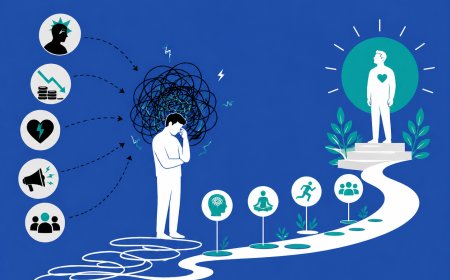
There is a quiet tension that emerges in professional life—one that is rarely spoken but deeply felt. You watch others ascend. Titles change around you. Positions expand. And you remain in place. Not failing, not regressing, but not advancing in the visible sense. It is in this space that the most dangerous interpretation begins: that growth has stopped.


But the real question is not whether you have moved upward.
It is whether you have moved at all.
In most institutional cultures, success is simplified into a single dimension: vertical progression. A higher role, a broader authority, an increase in income. These markers are visible, measurable, and easy to compare. But they are incomplete. Because they assume that growth is linear, that development happens only in one direction, and that every upward move is a sign of maturity.
This assumption is flawed.
There exists another form of movement—less celebrated, less visible, but often more transformative: lateral growth. The transition between roles, functions, or environments at the same hierarchical level. On the surface, it appears static. In reality, it expands the individual’s internal map.
When a person moves from one domain to another—marketing to operations, private sector to public, technical to strategic—they are not repeating their experience. They are reconstructing it. They are forced to re-learn systems, to question assumptions, to operate without the comfort of familiarity. This disrupts routine, and routine, while efficient, can quietly limit development.
Lateral movement breaks that limitation.
It transforms the individual from a specialist confined to one perspective into a thinker capable of understanding systems in their entirety. It builds what vertical progression often cannot: adaptability, contextual intelligence, and the ability to see connections across functions.
And this is where the paradox appears.
Those who ascend later are often those who moved more in the early stages. Not upward, but across. Not toward position, but toward understanding. They delayed visible progress in exchange for deeper capacity.
This creates a form of strength that is not immediately recognized, but becomes decisive over time.
Because leadership is not defined by authority alone. It is defined by comprehension. The ability to make decisions that account for multiple variables, to anticipate consequences beyond a single function, to align diverse parts of an organization into a coherent direction.
This cannot be built through a single path.
It requires exposure.
Yet many misinterpret delay.
When promotion does not arrive at the expected time, it is often perceived as rejection. A signal of inadequacy. A failure of recognition. This interpretation is understandable, but it is incomplete. Because it assumes that the organization’s timeline is the only valid measure of value.
It is not.
Value, in its deeper sense, is cumulative. It is built through impact, influence, and capability. These elements do not always translate immediately into titles. But they form the basis upon which sustainable advancement is built.
This requires a shift in perspective.
From rank to impact.
From recognition to construction.
A person who builds influence—who contributes to key decisions, supports others, solves problems, and creates clarity—develops a form of authority that exists independently of formal position. These individuals become reference points. Others seek them out. Their presence shapes outcomes.
This is informal power.
And in many systems, it precedes formal promotion.
At the same time, psychological awareness becomes critical. Comparison, if unmanaged, distorts perception. It shifts attention away from personal trajectory toward external validation. This leads to frustration, resentment, and disengagement.
But when delay is reframed as a phase rather than a verdict, it becomes usable.
An opportunity to deepen expertise, expand networks, and reassess direction. Not as passive waiting, but as active construction.
Because eventually, a decision must be made.
To continue within the current structure, or to move beyond it.
And here, strategy becomes essential.
Promotion is not a guarantee. It is an outcome. And like all outcomes, it can be influenced. Through clarity of direction, through deliberate skill-building, through positioning within systems that recognize and reward the type of value being created.
This requires understanding the environment.
What skills are valued? What problems need solving? Who makes decisions? What patterns lead to advancement?
Without this understanding, effort remains diffuse.
With it, effort becomes targeted.
And sometimes, the conclusion is clear: the current environment cannot support the desired trajectory. In such cases, movement outward is not abandonment. It is alignment. A strategic repositioning toward a system that matches the individual’s direction.
But regardless of the path—internal or external—one principle remains constant:
Do not wait for the role to begin acting at its level.
Those who are eventually promoted are often those who have already been performing the function before it was formally assigned. They demonstrate capability before recognition. They create a reality that the system must eventually acknowledge.
This is the difference between requesting advancement and making it inevitable.
In the end, the career ladder is not climbed passively.
It is constructed.
Through movement, through understanding, through deliberate positioning. And sometimes, through the willingness to step sideways in order to move forward in a way that others cannot yet see.
Because growth is not always visible.
But it is always structural.
What's Your Reaction?