



















































































The Engineering of the Mind: How Daily Habits Build Your Identity
Identity is not fate; it's a project built through repetition. Learn how your daily habits and thoughts, both good and bad, shape your character and why disciplined self-engineering is essential for personal growth.
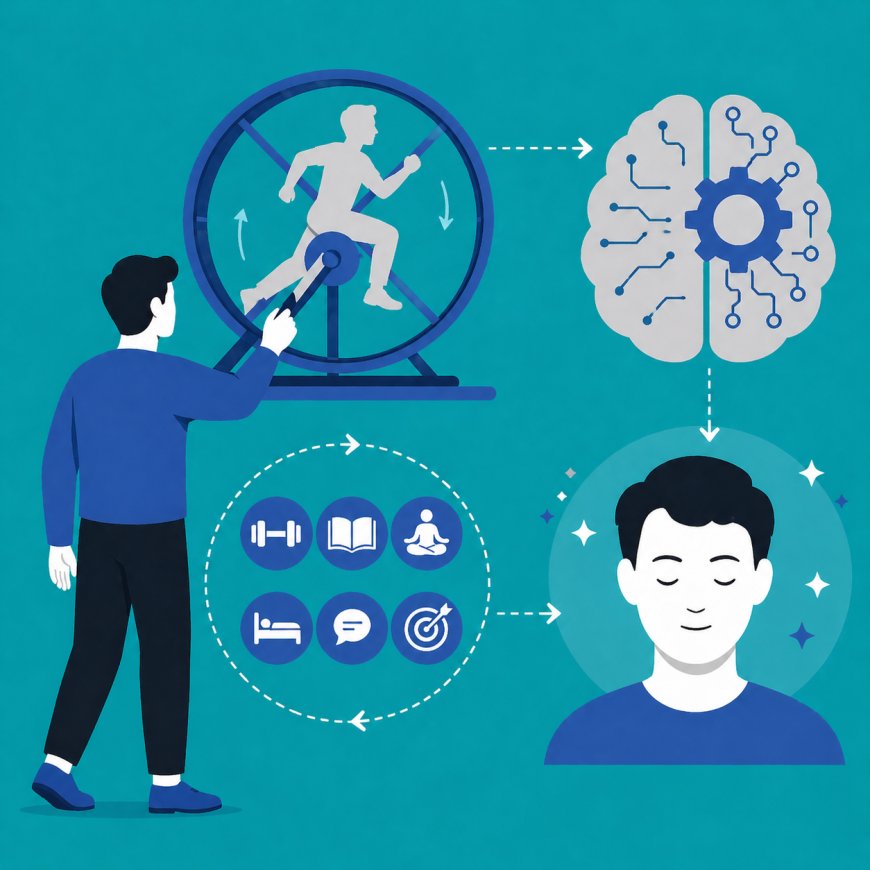
There is a contract every person signs, though no one remembers the moment of agreement. It is not written, not spoken, and not consciously negotiated. Yet it is renewed daily, through action, through silence, through what is tolerated and what is resisted. This contract defines far more than temporary behavior. It quietly determines direction. It shapes character. It prepares the self for how it will respond when faced with pressure, uncertainty, or choice.


What is often misunderstood is where this contract is actually formed. It is not built in moments of clarity or ambition. It is built in repetition. In what you do when no one observes. In what you allow when you are tired. In how you think when resistance appears. These moments, which seem insignificant in isolation, are in fact structural. They accumulate. And over time, they form something solid—either a system that supports you or one that confines you.
The mind, by design, does not evaluate repetition morally. It does not reward what is right or punish what is wrong. It strengthens what is practiced. It becomes efficient at what is repeated. Whether that repetition consists of discipline or delay, clarity or confusion, effort or avoidance, the result is the same: it becomes easier to access, faster to execute, and more likely to reappear.
This is why repetition must be understood as a system, not as isolated behavior. It is not the single action that defines you, but the pattern it participates in. A moment of hesitation is not failure. But repeated hesitation becomes identity. A brief lapse is not decisive. But normalized lapse becomes expectation. The danger is rarely in the exception. It is in what becomes routine.
And routine, once established, operates with minimal effort.
The mind prefers efficiency. When a pattern has been repeated enough, it becomes automatic. It no longer requires active decision-making. It executes. This is why, under pressure, people do not rise to their intentions. They return to their conditioning. When energy is low, when focus is reduced, when circumstances are unstable, the mind defaults to what it knows best—not what it aspires to, but what it has practiced most.
This creates a subtle but powerful constraint.
Many believe that intention is enough to guide behavior. That clarity of goals will eventually override inconsistent habits. But the structure of the mind does not support this assumption. Intention without repetition remains fragile. It has no foundation. It cannot sustain itself under stress. Only what has been practiced repeatedly becomes stable enough to persist when conditions are unfavorable.
This is why it is insufficient to ask what you want to become. The more precise question is: what are you training yourself to become?
Because every repeated thought, every tolerated behavior, every unchallenged pattern contributes to that training. Even experiences that seem passive—prolonged doubt, recurring frustration, habitual comparison—are not neutral. They are rehearsals. They strengthen specific pathways, making them more accessible in the future.
Over time, these pathways become references.
And references guide decisions without being consciously recognized. When faced with a new situation, the mind does not start from zero. It retrieves. It searches for familiar patterns and applies them. If the dominant reference is avoidance, avoidance becomes the default. If the dominant reference is persistence, continuation becomes more natural.
This is why identity cannot be treated as fixed.
It is not something you discover once and then maintain. It is something that is continuously constructed. A project, rather than a definition. And like any project, it depends on design. Without deliberate structure, it develops passively, influenced by whatever is most frequently encountered and repeated.
This brings attention to inputs.
What you read, what you listen to, what you think about when your mind is unoccupied—these are not peripheral elements. They are materials. Each one contributes to the internal architecture. Each voice you allow to remain influences the direction of construction. Over time, the distinction between internal and external disappears. What you consume becomes how you think. And how you think becomes how you act.
This is why boundaries are necessary.
Not as restrictions, but as protections. Just as physical structures require controlled environments to be built correctly, the mind requires selective exposure. Not everything deserves access. Not every idea deserves repetition. To allow constant noise, inconsistency, and superficiality into your thinking is to weaken the structure you are attempting to build.
The alternative is deliberate engineering.
To choose what is repeated. To reinforce patterns that align with the direction you intend to move. To interrupt those that do not. This does not require perfection. It requires awareness and consistency. The goal is not to eliminate all negative patterns instantly, but to reduce their frequency and strengthen more constructive ones over time.
Progress, in this context, is cumulative.
Small adjustments in repetition produce disproportionate effects over longer periods. A single action changes little. But repeated action reshapes the system. It alters what feels natural. It changes what requires effort and what does not. And eventually, it redefines identity—not through declaration, but through demonstration.
Because identity, at its most functional level, is simply the sum of what you consistently do.
Not what you intend. Not what you imagine. Not what you claim.
What you repeat.
And this leads to a final constraint that cannot be avoided: you cannot repeatedly act in contradiction to what you want to become and expect alignment to occur on its own.
The system does not correct itself.
It reflects input.
So the responsibility becomes clear. Not to control every thought, nor to eliminate every lapse, but to ensure that what is practiced most is aligned with what is desired most.
Because over time, repetition does not just influence behavior.
It becomes you.
What's Your Reaction?