









































































Deconstructing Geochemical Paradigms: Rethinking Elemental Classification and Interactions
Challenging the established classification of elements in geochemistry invites fresh perspectives on elemental interactions and isotope behavior. By re-evaluating geochemical frameworks, scientists are uncovering new insights into Earth's processes, questioning fundamental assumptions, and exploring novel methodologies for studying elemental interactions.

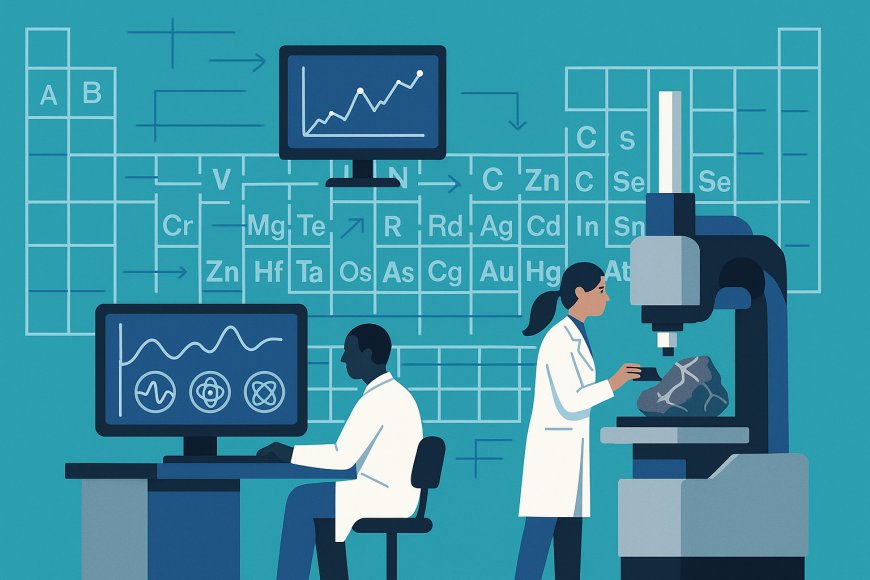
In the vast field of geochemistry, the traditional classification of elements has long been regarded as a cornerstone. However, recent strides in isotope analysis and elemental interaction studies are challenging these deep-seated categorizations. Consider a scenario where a research team investigates the isotopic signatures of trace elements in volcanic rocks. Here, the traditional classification of these elements does not adequately account for their complex, heterogeneous nature and interaction within the Earth's mantle. This lacuna presents a pressing need for rethinking geochemical paradigms.


In a typical observational study, researchers might examine the partitioning of elements between different mineral phases. By utilizing advanced spectroscopic techniques, insights are gleaned into the subtle influences of temperature and pressure on elemental behavior. These findings provoke fundamental questions regarding the conventional classification system. If temperature and pressure can significantly alter how elements distribute within minerals, does the current taxonomy accurately reflect the dynamic nature of geochemical processes?
The Limitations of Traditional Elemental Classification
The periodic table, a venerable tool in chemistry, categorizes elements based on atomic number and properties. However, in geochemical contexts, this rigid framework sometimes fails to capture the complexities of elemental interactions within Earth's systems. For example, in a controlled laboratory experiment, a team recreated high-pressure conditions found deep within the Earth to study the behavior of iron isotopes. Under such conditions, researchers observed isotopic fractionation patterns unaccounted for by conventional classification.
These observations suggest that the behavior of elements under extreme conditions requires a more nuanced approach. Traditional categories do not necessarily apply when elements interact under high-pressure environments. This realization pushes the scientific community to consider classification systems that accommodate temporal and spatial variability in elemental properties.
Furthermore, the societal application of geochemistry in mining and environmental science demands a more flexible classification system. The extraction of economically valuable elements often depends on understanding their precise geochemical behavior. A misclassification can lead to inefficiencies in resource extraction or missed opportunities for discovering new mineral deposits. Therefore, a re-evaluation of elemental categorization is not merely academic but has tangible economic implications.
Isotopic Analysis: A Catalyst for New Paradigms
Isotope geochemistry offers a fresh vista for re-examining elemental classification. Consider another behavioral experiment where researchers track the isotopic evolution of lead in ocean floor sediments. Through isotope ratio analysis, researchers discerned unexpected pathways of lead sequestration, challenging the preconceived geochemical cycles.
Such isotopic studies unveil complexities that static classification schemes cannot accommodate. They highlight the dynamic interplay of isotopes as they cycle through different geochemical reservoirs. In this way, isotopes act as subtle markers, revealing intricate patterns of elemental interaction and migration that transcend traditional categorizations.
Additionally, isotope analysis aids in reconstructing past environmental conditions, providing context for interpreting current geochemical processes. By understanding how isotopic systems have evolved over geologic time, researchers can reevaluate the assumptions underlying elemental classification. This temporal perspective enriches the methodology, paving the way for more adaptable and accurate geochemical frameworks.
Alternative Frameworks and Interdisciplinary Approaches
A paradigm shift in geochemical classification calls for interdisciplinary approaches. Scholars from fields such as materials science and environmental engineering are contributing new methodologies and theoretical perspectives. For example, consider a collaborative project where computational models simulate element behavior under varying geochemical conditions.
These simulations reveal potential alternative frameworks that better account for the complexity of elemental interactions. By integrating computational predictions with empirical data, researchers propose hybrid classification systems that blend traditional geochemical metrics with dynamic, context-specific criteria.
Such interdisciplinary efforts also extend beyond academic research. Policy-making in resource management benefits from these novel approaches by enabling more accurate assessments of mineral resources. Improved elemental classification systems facilitate sustainable extraction practices, aligning economic interests with environmental stewardship.
The exploration of alternative classification frameworks is not confined to theoretical discourse. Practical applications in environmental remediation highlight their utility. For instance, understanding heavy metal behavior in contaminated soils informs remediation strategies. A more accurate classification leads to targeted approaches, enhancing the efficacy of clean-up efforts.
As we reevaluate geochemical paradigms, we embark on a journey that challenges the status quo. By embracing alternative frameworks and interdisciplinary collaboration, we open new avenues for understanding Earth's intricate geochemical processes. This endeavor holds promise for scientific innovation and offers a more comprehensive perspective on elemental interactions and classifications.
The pursuit of reimagined geochemical frameworks reflects a broader scientific ethos—one that values adaptability, innovation, and critical re-examination of established ideas. As researchers continue to explore these new paradigms, they contribute to a deeper, more nuanced understanding of the Earth’s complex geochemical systems. This ongoing inquiry not only reshapes theoretical foundations but also impacts practical applications in resource management and environmental science, heralding a future where geochemical insight leads to sustainable practices and informed policy decisions.
What's Your Reaction?