
















































































Are Popular Saudi Dishes Really Healthy? A Critical Nutritional Analysis
A critical look at the nutritional content of popular Saudi dishes, challenging the myth that traditional food is inherently healthy and exploring its link to modern health problems.
Popular dishes often occupy a space that extends beyond nutrition into identity, memory, and social belonging. In many contexts, they are not evaluated based on their nutritional composition, but are instead protected by cultural meaning. This creates a fundamental tension between inherited perception and scientific reality.


Between nutrition and identity
The assumption that traditional dishes are inherently healthy did not emerge from scientific evaluation, but from a set of deeply rooted perceptions:
The association between the past and purity leads to the belief that older food practices are automatically healthier.
The comparison with modern fast food creates a relative illusion of superiority, even when traditional dishes may contain excessive fats, salt, or refined carbohydrates.
The fusion between food and identity makes criticism socially sensitive, as it is often perceived as a critique of culture itself.
This combination allows traditional meals to escape objective analysis.
The hidden shift in consumption patterns
Historically, many of these dishes were not part of daily intake. They were prepared for specific occasions such as gatherings or celebrations.
With modern abundance, these meals have transitioned into routine consumption. The context has changed, but the portion sizes and preparation methods often remain the same, creating a mismatch between tradition and modern lifestyle.
Nutritional structure of common dishes
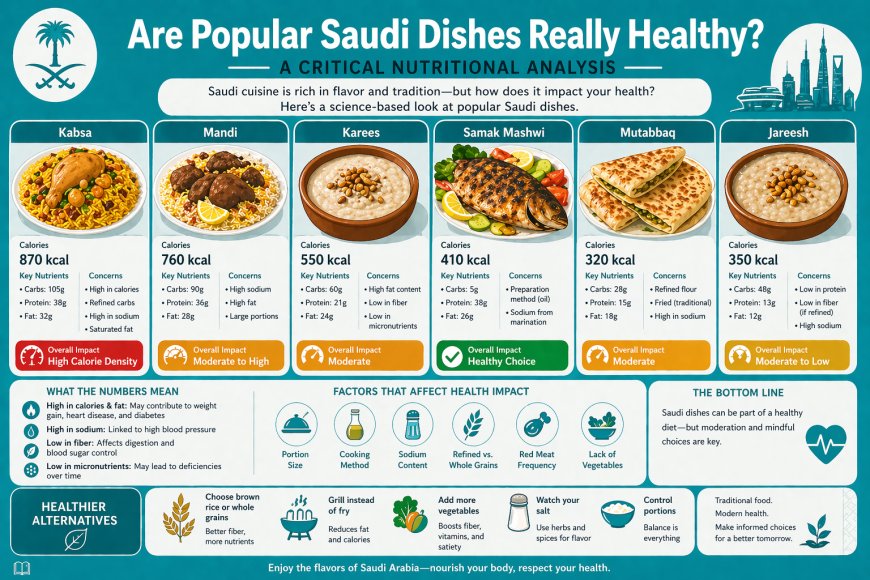
When examined scientifically, many traditional meals reveal an imbalance in composition, often combining high levels of carbohydrates with saturated fats and limited fiber.
Jareesh
A wheat based dish mixed with milk and fat. It provides moderate protein but becomes calorically dense when fat content increases.
Ma'soob
A mixture of banana, bread, sugar, and fat. Despite containing natural ingredients, it delivers a high glycemic load and promotes rapid insulin spikes.
Marqooq
A dough based dish with broth, vegetables, and meat. While vegetables provide some balance, the overall carbohydrate load remains high.
Chicken Kabsa
A rice based dish with protein. Nutritional value depends on preparation, but portion size significantly influences caloric intake.
Saleeq
Rice cooked with milk and butter. Its smooth texture encourages overconsumption, while its nutritional profile lacks fiber balance.
Harees
A more balanced option when prepared with minimal fat, offering stable energy and moderate protein content.
Hineni
A combination of dates, flour, and fat. It functions more as a dessert due to its high sugar and calorie density.
Thareed
Bread soaked in broth with limited fiber. It provides satiety but lacks nutritional balance when consumed frequently.
The core issue: perception versus reality
The challenge is not the existence of these dishes, but the way they are understood and consumed. Cultural value has overshadowed nutritional evaluation, leading to a normalization of imbalance.
Calories in these meals can range between moderate and very high levels, but the more critical factor is composition. High carbohydrate and fat combinations, combined with low fiber intake, contribute to long term metabolic risks.
Reframing the role of traditional food
The objective is not elimination, but repositioning. Traditional dishes should return to their original context as occasional meals rather than daily dietary foundations.
Understanding their composition allows for conscious adaptation, whether through portion control, modification of ingredients, or frequency of consumption.
Conclusion
The perception of traditional food as inherently healthy is not supported by scientific analysis. It is a constructed belief shaped by nostalgia, comparison, and identity.
Reevaluating this relationship does not diminish cultural value, but restores balance between heritage and health.
What's Your Reaction?