










































































The Subtle Art of Protein Folding: Navigating the Molecular Origami
Protein folding, the intricate process by which polypeptide chains acquire distinct three-dimensional structures, is a cornerstone of molecular biology. This phenomenon underpins the functionality of proteins, dictating their interactions and roles within biological systems. Folding is driven by a combination of hydrophobic interactions, hydrogen bonds, and van der Waals forces, guiding the chains through a complex energy landscape towards their native states. However, deviations in this process can lead to pathogenic misfolding, implicated in diseases like Alzheimer's and Parkinson's. Advances in computational biology and structural biochemistry hold promise in elucidating folding pathways, offering insights into therapeutic interventions. As we deepen our understanding of molecular origami, we edge closer to manipulating protein dynamics for biomedical applications.

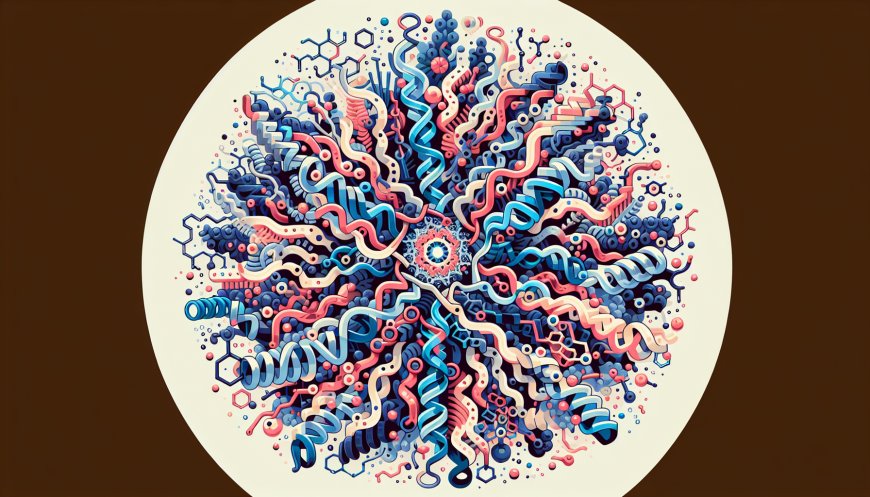
Proteins, the molecular workhorses of the cell, owe their diverse functionalities to the specific three-dimensional structures they attain post-synthesis. This dynamic process, known as protein folding, is crucial for the proper functioning of biological systems. From enzymatic catalysis to signal transduction, the role of correctly folded proteins cannot be overstated. As these polypeptide chains emerge from ribosomes, they commence a journey through the intricate landscape of molecular interactions to achieve their energetically favorable configurations.


The phenomenon of protein folding is primarily driven by the principles of thermodynamics and chemistry. Hydrophobic interactions, hydrogen bonding, and van der Waals forces collectively guide the polypeptide chains as they navigate the energy landscape, avoiding local minima traps to achieve their native state. This complex process, often compared to molecular origami, is dictated by both the sequence and the environment, with the cellular milieu playing a significant role in modulating folding pathways. The native conformation of a protein is a testament to the delicate balance of these forces, emblematic of the evolutionary optimization of protein structures.
Despite the intrinsic propensity of proteins to fold autonomously, the cellular environment is fraught with potential pitfalls that can impede proper folding. Molecular chaperones, a class of specialized proteins, are instrumental in mitigating these challenges. They assist newly synthesized proteins in navigating through potential folding errors, preventing aggregation and ensuring efficient attainment of native conformations. Chaperones also play a pivotal role in the cellular response to stress, aiding in the refolding or degradation of misfolded proteins, thus maintaining proteostasis and cellular health.
Unraveling the Complexity: Forces and Mechanisms Behind Protein Folding
At the core of protein folding lies a delicate interplay of physical forces and biochemical interactions. The primary structure of a protein, dictated by its amino acid sequence, encodes the folding information, but the realization of functional tertiary structures requires navigating a multifaceted energy landscape. The hydrophobic effect is a major driving force, as nonpolar residues tend to avoid the aqueous cellular environment, propelling the chain into configurations that minimize solvent exposure.
Additionally, hydrogen bonds stabilize secondary structures like alpha helices and beta sheets, while van der Waals interactions contribute to packing density within the protein core. Electrostatic interactions, though weaker, play a role in maintaining domain stability and specificity. These forces collectively orchestrate a folding funnel, guiding the polypeptide chain towards its thermodynamically stable native state. This process is akin to solving a complex puzzle, where each piece must align precisely to ensure functional integrity.
Modern research leverages computational models and biophysical techniques to illuminate the intricacies of folding pathways. Molecular dynamics simulations, for instance, provide insights into transient states and folding intermediates, revealing potential bottlenecks and alternative routes a protein may take. Advances in cryo-electron microscopy and nuclear magnetic resonance spectroscopy have further enhanced our ability to visualize folding at atomic resolution, offering unprecedented glimpses into the dynamism of protein conformation changes.
In spite of these insights, the precise mechanisms by which proteins overcome kinetic barriers and achieve their native states remain a topic of intense research. The energy landscape model posits that proteins undergo a series of intermediate states, each with its own energetic characteristics, before settling into the native conformation. This concept underscores the stochastic nature of folding, where multiple pathways and outcomes are possible, influenced by both intrinsic and extrinsic factors.
Implications of Misfolding: From Disease Pathogenesis to Therapeutic Strategies
The stakes of protein folding extend beyond cellular functionality, as errors in this process have been implicated in a myriad of diseases. Misfolded proteins can aggregate into insoluble fibrils, disrupting cellular homeostasis and leading to pathologies such as Alzheimer's disease, Parkinson's disease, and amyotrophic lateral sclerosis. These neurodegenerative disorders are characterized by the accumulation of proteinaceous plaques and tangles, underscoring the critical need for understanding folding failures.
Research into misfolding mechanisms has revealed that certain sequence motifs predispose proteins to aggregation, a process exacerbated by environmental stressors and genetic mutations. The cellular machinery, including the ubiquitin-proteasome system, attempts to mitigate these aberrations through degradation pathways, yet overwhelmed systems can lead to cellular toxicity and apoptosis.
The burgeoning field of pharmacological chaperones aims to rectify folding abnormalities by stabilizing native conformations or redirecting misfolded proteins towards degradation. These small molecules are designed to mimic the action of molecular chaperones, providing therapeutic potential in addressing protein misfolding disorders. Additionally, gene editing technologies offer promising avenues for correcting genetic predispositions towards misfolding, potentially altering the course of inherited diseases.
Looking forward, a deeper comprehension of folding dynamics could inform the design of synthetic proteins with tailored functionalities. This could revolutionize biotechnological applications, from enzyme engineering to drug delivery. By harnessing the principles that govern folding, researchers aspire to craft proteins with bespoke properties, pushing the boundaries of what is biochemically conceivable.
The ongoing exploration of protein folding reveals not only the elegance of nature's solutions but also the potential for innovation in addressing human health challenges. As our understanding of molecular origami deepens, we inch closer to mastering the ability to manipulate these processes, heralding a new era of biotechnological advancement.
In conclusion, the art of protein folding is a testament to the complexity and precision inherent in biological systems. It is both an enabler of life and a potential harbinger of disease, poised at the intersection of molecular biology and biochemistry. As scientific inquiry continues to unravel the mysteries of folding, the potential for therapeutic interventions and biotechnological innovations becomes increasingly tangible.
Future research endeavors will likely focus on elucidating the finer details of folding kinetics and the environmental factors that influence this process. By mastering these intricacies, the scientific community stands to unlock new frontiers in understanding disease mechanisms and developing innovative therapeutic strategies, paving the way for a future where molecular origami is not just a natural phenomenon but a tool for human advancement.
What's Your Reaction?