Simulation Models: A Strategic Tool for Decision-Making and Planning
This article explains what simulation models are and their strategic importance in modern planning, from urban development and traffic management to business and social policy.
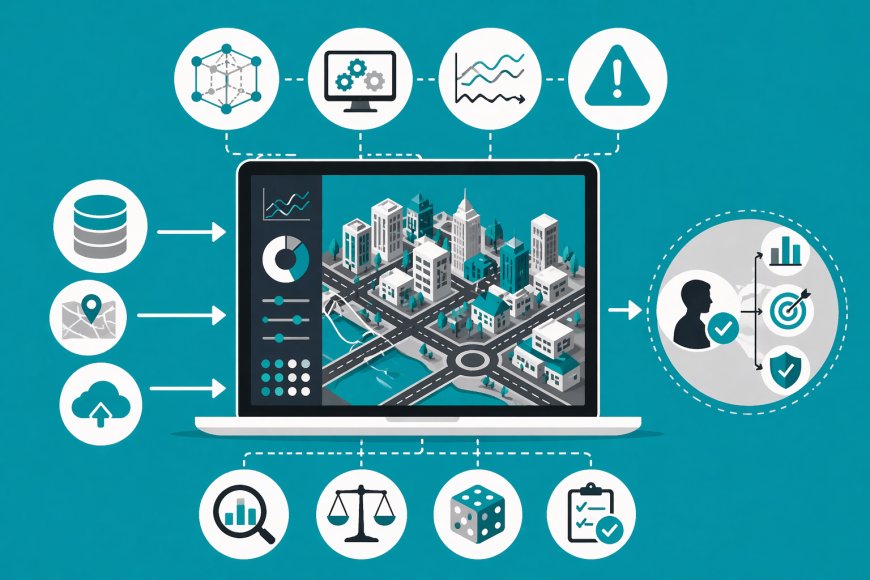
In a world where decisions accelerate under the pressure of data and system complexity, simulation models emerge as a cognitive and strategic tool that allows institutions to replicate reality and explore the future within controlled environments. Developing a simulation model is no longer a theoretical exercise, but a practical necessity to enhance understanding, assess risks, and test solutions before engaging with real-world consequences.


Simulation: from replication to behavioral modeling
A simulation model is a digital or mathematical representation of a real system designed to explore its behavior under changing conditions. When developed professionally, it evolves from a descriptive tool into a predictive and strategic instrument. In this form, simulation becomes a cognitive laboratory that integrates quantitative analysis with forward-looking insight.
IDM model: simulating traffic dynamics
One of the most recognized examples is the Intelligent Driver Model (IDM), which simulates driver behavior and interactions on roads. It models responses to speed, distance, and environmental changes.
Its application extends beyond understanding congestion to evaluating infrastructure changes, adaptive traffic systems, and emergency interventions. Through such models, decisions are no longer based on intuition alone, but on measurable virtual experiments.
Modeling the future: expanding planning imagination
The strength of simulation lies in its ability to visualize scenarios that have not yet occurred. This “what if” thinking enables decision-makers to explore multiple pathways and evaluate their consequences with minimal cost.
Simulation models can assess the impact of urban expansion, policy changes, or infrastructure development before implementation. This requires integration between technical modeling, behavioral understanding, and domain expertise.
Scientific steps for developing simulation models
Developing a robust simulation model follows a structured methodology:
Defining the objective
Every model begins with a clear question. The value of simulation is tied directly to its relevance to a measurable decision or problem.
Building the conceptual model
Before technical implementation, the system’s relationships must be mapped: actors, inputs, outputs, and interactions.
Selecting tools and platforms
Different simulation environments serve different purposes, from detailed micro-level models to broader system-level representations.
Calibration and validation
Models must be tested against real data to ensure accuracy. Without validation, simulation loses its credibility.
Scenario generation and interpretation
A successful model produces multiple scenarios, allowing decision-makers to evaluate alternatives and anticipate outcomes.
Simulation as strategic capital
Simulation models generate value across multiple dimensions:
Operational benefits
They allow testing of decisions without real-world disruption, improve coordination, and build institutional learning based on data rather than assumptions.
Economic benefits
Simulation reduces costs associated with failed decisions, directs investments toward validated solutions, and supports efficient resource allocation.
Social benefits
It enhances transparency, reveals disparities, and supports informed policymaking by enabling stakeholders to visualize outcomes before implementation.
Testing initiatives and decisions
Simulation transforms ideas into testable structures. Instead of implementing decisions directly, institutions can evaluate them in virtual environments.
This process:
- Reveals strengths and weaknesses across scenarios
- Identifies indirect consequences
- Bridges the gap between strategy and execution
It shifts organizations from intuition-driven systems to evidence-based environments.
Simulation as a strategic vision
Simulation is not merely a technical tool but a transformation in how institutions perceive and navigate reality. It does not replace decision-making but deepens its quality by mapping risks and opportunities in advance.
Organizations that adopt simulation as part of their strategic framework gain the ability to experiment, adapt, and act with greater precision. In this context, IDM stands as an example of how simulation can be embedded into institutional intelligence, enabling decision-makers to test and refine their strategies before execution.
What's Your Reaction?