Surviving Statistics: the Cox Proportional Hazards Model
Immerse yourself in the key concepts of the Cox Proportional Hazards Model, a cornerstone of survival analysis. Learn the nuts and bolts of the model, its real-world applications, software applications, and potential limitations.

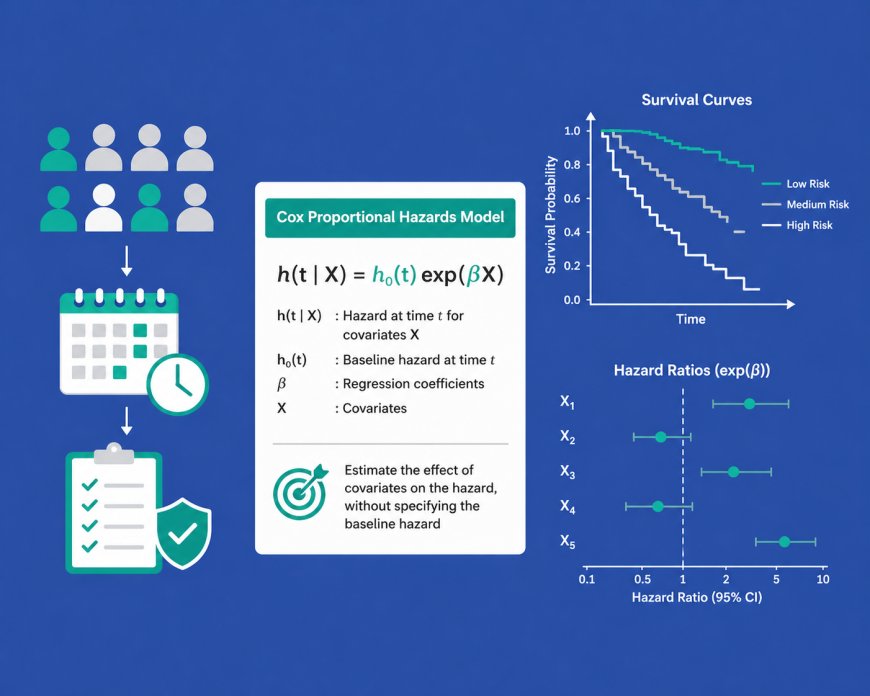
The Cox Proportional Hazards Model is one of the most important tools in survival analysis, because it helps researchers study not only whether an event happens, but when it happens. This event may be death, disease recurrence, recovery, hospital readmission, machine failure, or any outcome where time is part of the question. In many studies, knowing the final outcome alone is not enough. Two patients may both survive, but one may relapse after two months while another remains disease-free for five years. Two machines may both fail, but the timing of failure carries essential information. This is where survival analysis becomes necessary, and where the Cox model becomes especially useful.


The strength of the Cox model lies in its ability to estimate the effect of several predictors on the hazard of an event occurring at a given time. The hazard does not mean the probability that the event will ever happen. Rather, it refers to the instantaneous risk of the event occurring at a specific point in time, given that the individual has not yet experienced the event. This distinction is important, because survival analysis deals with follow-up periods, incomplete observations, and changing risk over time.
The model includes two main parts. The first is the baseline hazard, which represents the underlying hazard when all predictor variables are held at zero or at their reference level. The second part is the exponential function that includes the covariates, such as age, sex, treatment group, disease severity, smoking status, or any other relevant predictor. The model does not require researchers to specify the exact shape of the baseline hazard, which makes it more flexible than fully parametric survival models.
The most familiar result from the Cox model is the hazard ratio. A hazard ratio above 1 indicates a higher hazard of the event, while a hazard ratio below 1 indicates a lower hazard. For example, if a treatment has a hazard ratio of 0.70, this suggests that the treated group has a 30% lower hazard of experiencing the event compared with the reference group, assuming all other variables in the model are held constant. If smoking has a hazard ratio of 1.50, this suggests a 50% higher hazard compared with non-smoking, again assuming the model is correctly specified.
The central assumption of the Cox model is the proportional hazards assumption. This means that the relative effect of each predictor is assumed to remain constant over time. In simple terms, if one group has twice the hazard of another group at the beginning of follow-up, the model assumes that this relative difference remains twice as high throughout the follow-up period. If this assumption is violated, the model may produce misleading estimates. Therefore, checking proportional hazards is not optional; it is a necessary step before interpreting the model with confidence.
Despite its flexibility, the Cox model has limitations. It is not ideal when hazards change substantially over time unless the model is adapted to account for that. It is also not the best choice when there are competing risks, such as when different types of events prevent the event of interest from occurring. In addition, time-dependent covariates require special handling, because standard Cox models assume that predictors are fixed or measured at baseline unless otherwise specified.
In practice, the model can be fitted using common statistical software. In SPSS, it is available through the survival analysis procedures. In R, the coxph() function from the survival package is commonly used. In Stata, researchers use stcox, and in SAS, the equivalent procedure is PROC PHREG. However, the technical execution is the easiest part. The true skill lies in defining the event correctly, coding the time variable accurately, handling censored observations, checking assumptions, and interpreting hazard ratios without overstating causality.
Censoring is one of the reasons survival analysis is powerful. In many studies, some participants do not experience the event before the end of follow-up, or they may be lost to follow-up. These observations still contain valuable information because they tell us that the event did not occur during the observed period. The Cox model can incorporate these censored cases rather than excluding them, which helps preserve statistical power and reduce bias.
The Cox Proportional Hazards Model remains a pillar of applied research because it allows researchers to evaluate multiple risk factors simultaneously while accounting for time. It is widely used in medicine, epidemiology, public health, engineering, and social sciences. Yet, like every statistical model, it is only as valid as the assumptions, data quality, and interpretation behind it.
In the end, the Cox model does not simply answer whether a factor is associated with an event. It answers a deeper question: how does this factor shape the timing and risk of that event while controlling for other variables? This is what makes it one of the most valuable models for researchers working with time-to-event data.
What's Your Reaction?