

















































































Why the Sky Is Blue: Rayleigh Scattering Explained
Discover why our daytime sky appears blue and sunsets glow red. This science explainer unpacks Rayleigh scattering—the interaction of sunlight with tiny molecules in Earth's atmosphere—and explains how wavelength, particle size and human vision combine to create the colors we see.


When we look up on a clear day, the sky greets us with a serene blue dome. At sunrise or sunset, that same sky burns with hues of red and orange. These colours are not a trick of the eye but the result of subtle interactions between sunlight and Earth's atmosphere. To understand why the sky is blue we need to explore the nature of light and the way it scatters as it travels through air.


Sunlight as a Spectrum
Sunlight appears white, but it is actually a mixture of many colours corresponding to different wavelengths of electromagnetic radiation. The visible portion of the spectrum spans from roughly 380 nanometres (violet) to about 750 nanometres (red). Shorter wavelengths like violet and blue carry more energy and oscillate more rapidly than longer wavelengths like red. When all these colours are combined, we perceive the light as white. A prism or raindrop can separate white light into its component colours, producing a rainbow. The key to the sky's colour lies in how these wavelengths interact with molecules and tiny particles in the air.
What Is Rayleigh Scattering?
The dominant mechanism behind the blue sky is **Rayleigh scattering**, named after the British physicist Lord Rayleigh. This phenomenon occurs when light interacts with particles that are much smaller than its wavelength. In Earth's atmosphere, those particles are primarily nitrogen and oxygen molecules. When sunlight strikes these molecules, it sets their electrons into oscillation. The oscillating electrons then re‑radiate the light in all directions. Importantly, the efficiency of this scattering is inversely proportional to the fourth power of the wavelength. This means shorter wavelengths (violet and blue) scatter much more strongly than longer wavelengths (yellow, orange and red).
Imagine sunlight as a beam of many coloured threads entering the atmosphere. The blue and violet threads are quickly tugged away by air molecules and sent ricocheting throughout the sky, while the red and orange threads travel straighter paths. When you look in a random direction away from the sun, you predominantly see the scattered blue light, giving the sky its characteristic colour.
Why the Sky Is Not Violet
Given that violet light has an even shorter wavelength than blue, you might wonder why the sky does not appear purple. There are two main reasons. First, the sun emits less violet light than blue, so there is simply less of it to scatter. Second, human eyes are less sensitive to violet wavelengths and more sensitive to blue and green. Furthermore, the upper atmosphere absorbs a significant portion of ultraviolet and violet light. These factors combine to shift the scattered light that reaches our eyes toward the blue end of the spectrum.
Sunset, Sunrise and the Path Through the Atmosphere
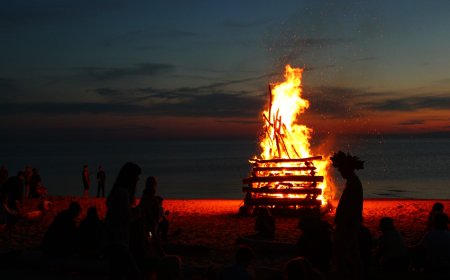
During midday, sunlight travels a relatively short path through the atmosphere before reaching you. At sunrise and sunset, however, the sun sits low on the horizon and its light must traverse a much longer distance through the air. Along this extended journey, most of the blue and violet light is scattered out of the line of sight, leaving behind the longer wavelengths. The result is a spectrum rich in reds and oranges, which paints the sky in warm tones. Dust, smoke and pollution can enhance these colours by adding larger particles that scatter light differently, a process known as **Mie scattering**. These particles tend to scatter all visible wavelengths more evenly, creating the white glare around the sun or the pale haziness of a humid afternoon.
Beyond Earth: Other Worlds and Phenomena
Rayleigh scattering is not unique to Earth. The blue haze seen on Mars during twilight, the orange hue of Titan's thick atmosphere and the deep blue of Neptune all owe their colours in part to scattering. The phenomenon also influences the brightness and colour of shadows on Earth. Shadows outdoors are rarely pitch black because the scattered light from the sky fills them with a soft bluish illumination. Photographers refer to this as "blue fill" and adjust their camera settings accordingly.
Practical Applications and Science
Understanding Rayleigh scattering has practical benefits. Astronomers must account for atmospheric scattering when observing celestial objects; the twinkling of stars and the reddening of distant mountains are both influenced by the thickness of the atmosphere through which the light travels. Environmental scientists measure the degree of scattering to infer the concentration of aerosols and pollutants, giving insight into air quality and climate effects. Engineers designing optical instruments such as telescopes and laser communication systems incorporate the scattering properties of air into their models to ensure accurate performance.
The phenomenon also has cultural and aesthetic ramifications. Artists and poets have long drawn inspiration from the shifting colours of the sky, and the science behind these colours adds depth to that appreciation. Knowing that every blue patch overhead is a tapestry woven from countless interactions between light and molecules can instil a sense of wonder about the seemingly mundane act of looking up.
The question "Why is the sky blue?" leads us into the heart of atmospheric physics. Rayleigh scattering, by preferentially redirecting short wavelengths of sunlight, bathes our world in a blue glow during the day and sets the stage for the fiery displays of dawn and dusk. It highlights the connection between the microscopic world of molecules and the macroscopic beauty of our environment. The next time you step outside on a clear day or marvel at a colourful sunset, remember that you are witnessing the interplay of light and matter on a planetary scale.
What's Your Reaction?